Artificial intelligence has moved beyond innovation initiatives and is becoming a standard capability for businesses of every size. Because of the numerous benefits, such as improved productivity and enhanced customer experiences, businesses are starting to use AI automation services to help employees work on fewer manual activities and more strategic work. AI is such a versatile technology that it can be used for a wide range of applications, from supporting employees with customer support to streamlining sales workflows.
The speed and magnitude of AI automation implementation into businesses raise questions within business circles. One such question is how much AI automation will cost. This is a prudent question to ask and analyze, as businesses are expected to become more innovative and productive when using AI automation services, but every business is unique, and costs are predicted to vary among businesses.
According to a 2025 global AI adoption survey, 88% of organizations use AI in at least one business function, which shows how artificial intelligence has become a core business capability rather than an emerging technology. Still, a lot of companies are figuring out how to scale AI effectively while keeping implementation costs under control.
The total cost of AI automation depends on things like the business objectives, how complicated the process is, and how much customization they want. It also hinges on the software platforms being used, how well systems integrations connect together, the state of data readiness, plus security requirements, and ongoing maintenance. If you look at these angles, it makes it easier for decision makers to set realistic budgets, choose the most precise solution, and end up getting the best long-term return on investment.
What Is AI Automation?
AI automation uses artificial intelligence alongside workflow automation to complete routine business processes with minimal human involvement. With help from smart tools, AI agents, and automated processes, organizations can speed things up, cut down on manual work, and boost accuracy, then scale operations more effectively through a dependable AI automation service.
◈ Common Areas Where Businesses Use AI Automation
⇒ Customer support automation
AI-powered chatbots answer routine customer questions, route support tickets, provide quick help immediately, and reduce overall response times while letting the support team concentrate on more complex problems, instead of getting stuck on the basics.
⇒ Sales and lead management
AI qualifies potential leads, updates CRM records, sets follow-up actions, prioritizes opportunities, and helps sales teams reach prospects sooner with personalized and timely outreach.
⇒ Marketing automation
AI automates email campaign work, and handles audience segmentation, suggests what content to show next, optimizes the whole campaign, and does performance reporting too, so customers stay more engaged and the marketing process runs smoother overall.
⇒ Finance and invoicing
AI helps speed up invoice processing, sends payment reminder messages, keeps an eye on expenses, supports financial reporting, and helps with reconciliation, which reduces manual mistakes, while boosting operational accuracy and keeping compliance more secure.
⇒ HR and recruitment workflows
AI helps make resume screening smoother, as well as interview scheduling, candidate messaging, employee onboarding, and document wrangling easier, so HR folks can hire faster and not get dragged into all that admin work.
⇒ Data entry and reporting
AI can capture and check business information on its own, arrange everything, produce reports, and share precise insights, while it keeps the repetitive manual typing and similar chores to a minimum.
⇒ Operations and task management
AI helps automate task assignments, workflow approvals, project tracking, and internal notifications, and it boosts cross-functional collaboration. At the same time, it keeps business operations organized and productive too, in a steadier way.
Why Understanding AI Automation Cost Matters
➥ Helps in Better Budget Planning
Understanding AI automation cost helps organizations plan more realistically, so they don’t get hit by surprise implementation expenses, and they can smartly spread money across software, development, integrations, upkeep, and ongoing assistance.
➥ Supports Better ROI Decisions
When you compare the implementation costs with the outcomes the business expects, the decision makers can identify higher impact automation opportunities faster, sort projects in a more deliberate manner, and maximize long-term operational and financial returns too.
➥ Reduces Risk of Overinvestment
Carefully evaluating business requirements helps avoid spending on advanced features or unused tools and nudges toward phased implementation, so financial risk stays minimal while supporting future business growth.
Key Factors That Affect AI Automation Cost
✦ Business Process Complexity
If a workflow is simple, it tends to need less configuration and development work, so it usually ends up more affordable. But when it’s complex, like multi-step processes that include multiple approvals, several departments, or even multiple decision points, it takes more attention in planning, testing, and later implementation.
✦ Type of AI Automation Solution
The selected AI automation service really does shift overall costs a lot. Depending on the setup, no-code platforms, custom AI agents, chatbots, and virtual assistants, plus AI-powered analytics and enterprise workflow automation, all require implementation effort, plus different technical resources.
✦ Level of Customization Required
Ready-made automation platforms are quicker and generally more affordable to deploy. But custom AI automation services end up needing additional development, testing, and optimization to support unique workflows, business rules, and operational requirements.
✦ Number of Integrations
When you connect AI automation with CRM, ERP, websites, email services, payment gateways, plus internal systems, the overall execution gets more complex. Each additional connection means further development, testing, verification, and then continued maintenance, all the way through rollout.
✦ Data Quality and Availability
Well-structured, accurate data makes AI implementation a lot easier, and it can lower project costs too. But if the data is inconsistent or unfinished, then usually you end up doing extra steps like cleaning, moving the records, validation, and preparation, before automation can actually bring dependable business results.
✦ AI Model and Technology Stack
The implementation expenses are not the same everywhere; it depends on what a business does, like using open-source models, third-party AI APIs, custom-trained models, or cloud-based infrastructure. These tech choices shape development effort, scalability, and long-term operating expenses.
✦ Security and Compliance Needs
Organizations that manage sensitive information need higher-level security controls, access management, regulatory compliance, and safe deployment practices. Hitting all of that takes more implementation effort and a heavier workload, but it also shields the business data and reduces compliance risks.
✦ Ongoing Maintenance and Support
With AI automation, there’s a need for continuous monitoring, fixing bugs when they appear, updating models, workflow tuning, and doing ongoing improvements to performance. Regular upkeep keeps the automation from drifting, makes it feel more dependable and precise, and it stays in step with changing business workflows as well as new technology shifts.
Also Read: Best AI Automation Company in India to Scale Business Operations
Common AI Automation Pricing Models
➔ Subscription-Based Pricing
Companies pay monthly or yearly charges to get access to SaaS automation platforms. This approach fits well for standardized AI automation solutions, since the costs are more predictable, there are frequent updates, plus the platform keeps getting ongoing maintenance and support.
➔ Project-Based Pricing
A fixed price is agreed on to deliver a defined automation project, with clear goals, timelines, and deliverables, so it becomes easier to budget for a company that has stable expectations or requirements.
➔ Hourly or Resource-Based Pricing
The price follows development hours, or the technical resource that is assigned, which makes this approach a good fit for automation work where the requirements shift a lot, changes happen often, or the implementation scope is not quite set.
➔ Custom Enterprise Pricing
Larger organizations usually get tailored pricing based on overall project complexity, deeper integrations, security needs, and dedicated support, plus growth readiness, enterprise-wide deployment, across several business functions.
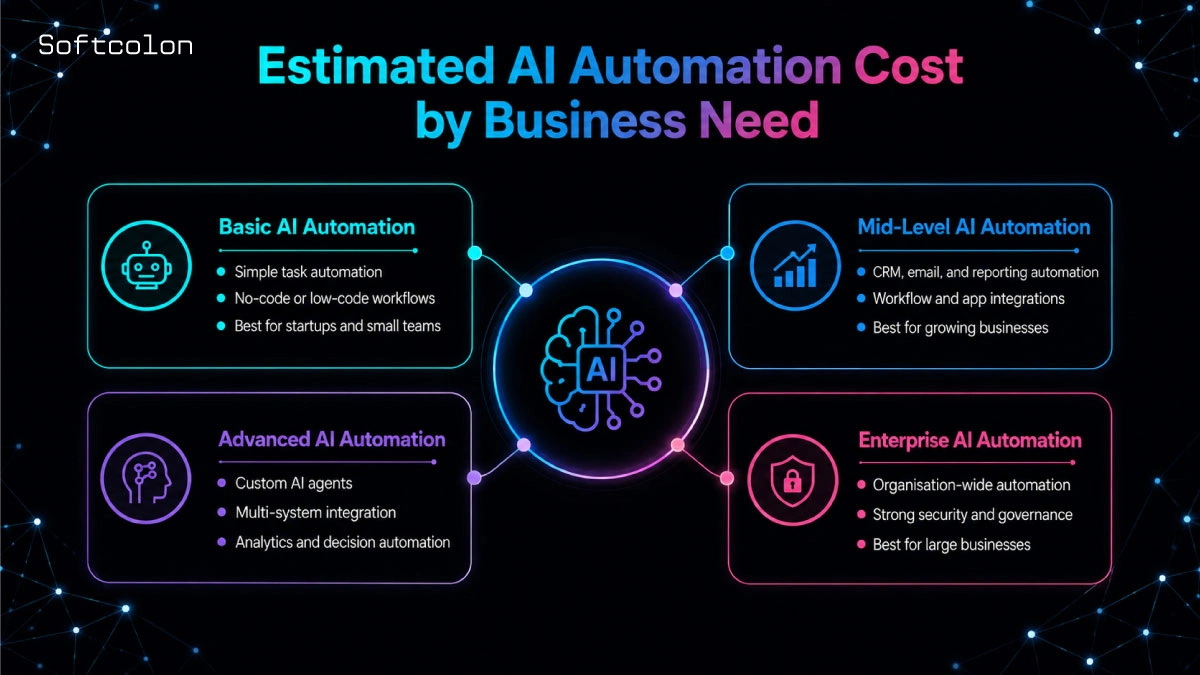
Estimated AI Automation Cost by Business Need
✧ Basic AI Automation
Basic automation mostly handles simple and repeated stuff, using no-code or low-code platforms. It fits well for startups and small businesses that are trying to get cheaper automation with fast launch and very low technical hassle.
✧ Mid-Level AI Automation
Mid-level AI automation connects CRM systems with email platforms, reporting tools, and workflow automation. It helps businesses that are getting bigger and need more operational efficiency, plus better coordination between different departments.
✧ Advanced AI Automation
Advanced AI automation is where you find custom AI agents, intelligent choices and reasoning, deeper analytics, and even more integrations across separate business systems, so it fits organizations that deal with complicated workflows and large datasets.
✧ Enterprise AI Automation
Enterprise automation helps support organization-wide digital transformation in an advanced way, with security, governance, scalability, and broad system integrations. The leading AI automation service providers build these solutions for big organizations that handle complex operations across several departments, and well, it all comes together with advanced controls.
Hidden Costs Decision Makers Should Consider
➔ Data Preparation Cost
Data preparation is an intensive process. It often involves cleaning duplicates, formatting inconsistencies, migrating datasets, and applying logic. Automation can not be successfully implemented if the quality of data is poor because it requires additional time and effort for the implementation process.
➔ Integration and API Cost
Integrating automation into business applications often requires the purchase of APIs and custom connectors. It may also require more development time. These costs continue to add up depending on the number of platforms and systems.
➔ Employee Training Cost
For automation to really work in the real world, you usually need employee onboarding, workflow training, and also change management that actually gets support. Having guidance from an AI automation specialist helps teams adopt these newer processes faster, and it tends to boost long-term productivity over time.
➔ Maintenance and Upgrade Cost
Regular software updates, workflow optimization, performance surveillance, bug fixing, and even model improvements are really necessary to keep automation accuracy intact, make the system reliable, and support long-term operational efficiency.
➔ AI Usage and Cloud Cost
Organizations must account for the cost of API tokens and the continual expense for hosting, storage, and computing, as these will increase the operating costs for AI and Automation.
Also Read: Top AI Integration Company in USA for Scalable AI Solutions
How to Calculate AI Automation ROI
➥ Measure Time Savings
Calculate how many hours employees save each week or every month after automation. With that reduced manual load, teams can put their attention on strategic duties instead of the same repetitive administrative stuff again and again.
➥ Measure Cost Savings
Check what operational expenses look like before automation and after, by tracking labor savings, diminished manual effort, lower processing costs, and better resource utilization across business functions.
➥ Measure Revenue Impact
Evaluate how faster lead replies, smoother customer journeys, higher conversion rates, and boosted sales efficiency affect real income. This helps you see how automation, directly, fuels growth that actually sticks around.
➥ Measure Process Accuracy
Keep an eye on how manual errors are reduced, watch for improved reporting accuracy and better decision making, in order to see whether automation actually tightens operational consistency and backs dependable business performance.
How Businesses Can Reduce AI Automation Cost
⦿ Start with High-Impact Use Cases
Select use cases that involve rule-based tasks with high levels of repetition to realize significant time and operational efficiencies. The first use cases to be automated are extremely important because they provide measurable positive returns that build confidence around automation efforts.
⦿ Use Phased Implementation
Begin with automation that is targeted at a specific area. This is followed by a review and refinement of the implemented automation that gradually allows a broader use of the automation. This approach allows a financial risk to be taken and ensures that the automation is aligned with the needs of the business.
⦿ Choose the Right Tools
Select automation solutions that mesh with business processes and the needs of the operations. When tools are properly selected, costs are controlled because there is an easier and more cost-effective implementation and a greater ease of ongoing use and scalability.
⦿ Improve Data Readiness
Business data needs to be clean and structured with data integrity before automation is implemented. The better the data is, the better the results of the automation and the cheaper the long-term costs because there are fewer issues with deployment and fewer concerns with incomplete records.
⦿ Work with the Right AI Automation Partner
Working with experts provides AI automation solutions services that really help a company get the right consultation, so they avoid costly implementation mistakes and build a more scalable automation system that sticks around for the long run, supporting day-to-day operations while businesses keep evolving.
AI Automation Cost for Small Businesses vs Enterprises
❖ Small Business AI Automation Cost
Small businesses in the emerging stage of automation using SaaS platforms will spend about $50 per month. For implementing customized workflows, you will be looking at $1,500 to $12,000, while advanced multimodal agent automation will cost over $25,000. This makes an AI automation agency a necessity to get the most cost-effective options.
❖ Mid-Market AI Automation Cost
Most mid-market businesses will spend anywhere from $30,000 to $150,000 or more during the first year of automation. Support and optimization in the following months will cost anywhere from $3,000 to $10,000, depending on how intricate and customized the automation and integrations are.
❖Enterprise AI Automation Cost
The monthly budget is anywhere from $5,000 to $50,000+ for Enterprise AI automation. In the first year, $25,000 to $100,000+ will be needed for automation and system integration. From there, the budget is dependent on the scale of automation across the enterprise, security, and the AI models and frameworks to be used.
When Should You Choose Custom AI Automation?
➞ When Ready-Made Tools Are Not Enough
Businesses that have their own workflows, tangled approval chains, or industry-specific requirements usually cannot rely on standard options. An AI automation agency can craft tailored automations that fit your operational needs.
➞ When Scalability Is Important
Custom automation for long-term digital transformation is beneficial for growing organizations with multi-department workflows. Such automation seamlessly expands with business operations, eliminating the need for disruptive and costly platform replacements due to limitations in scope.
➞ When Security and Control Matter
Private deployments are essential for automation servicing highly sensitive or regulated data due to the need for stronger security and compliance of business-critical data, combined with higher governance control.
Common Mistakes to Avoid While Budgeting for AI Automation
➣ Focusing Only on Tool Cost
The tool’s purchase price is only one component of the overall total cost of ownership. A complete cost assessment should include implementation, integration, maintenance, and long-term support expenses. Low-cost tools may result in a higher total cost of ownership due to required manual processes.
➣ Automating Without Clear Goals
Most organizations that undertake automation without well-defined goals usually incur higher costs due to significant time and effort with little improvement to business outcomes and processes. The end result is often increased complexity and poor automation.
➣ Ignoring Data Quality
Poor data lowers automation accuracy, adds more setup complexity, and also increases maintenance expenses. AI automation consulting services often begin by working on data readiness before deployment starts.
➣ Not Planning for Scalability
Picking a short-term solution without thinking about future growth can lead to costly upgrades, whole system replacements, and annoying implementation delays, because business needs slowly turn more complicated over time.
How to Choose the Right AI Automation Partner
➥ Check Technical Expertise
Look for partners with an excellent track record of AI development, strong knowledge of automation platforms, and the ability to design effective integrations, so you have the right solutions today and in the future.
➥ Review Industry Experience
Consider whether the partner has an understanding of your specific workflows and has accomplished similar automation in your industry. This kind of experience tends to result in an easier and faster deployment.
➥ Evaluate Support and Maintenance
Good partners will monitor the added automation for performance, constantly tune the system, and provide necessary updates to keep the automation performing well with changing business needs.
➥ Compare Cost with Long-Term Value
Instead of picking it only off the AI automation agency cost, try to look at the average cost for AI automation agency services next to the expected ROI, scalability, plus the ongoing support, and the long-term business value overall.

Ready to Plan Your AI Automation Budget Smartly?
Beginning with definite goals, an achievable budget, and a gradual rollout helps to ensure the success of an AI automation project. Focus on the specific workflows that provide significant business value at first. To avoid time-consuming and costly errors, work with experienced professionals. These professionals offer custom AI automation services and can implement the correct technologies and design frameworks that are both flexible and adaptable to support business growth.