For modern business, understanding top trends in AI is not an option but necessary for staying competitive and driving decision-making & driving sustainable growth. As the potential of AI rapidly increases, organization leaders and business leaders must focus on practical, high-impact trends that shape operations and customer experience for an ai agent development company.
2025 was the year when everyone talked about AI, but this year is all about implementing it in real-time business. Agentic AI is reshaping the organization by improving ROI, AI-human collaboration, building trust, and creating scalable AI projects. The AI agent market in 2030 is expected to grow to $50.31 billion. In a report, it was found that 1,500 IT experts are looking to implement an AI agent. Read the following guide to know what AI agent trends are and why they matter in 2026.
What Are AI Agents and Why They Matter in 2026
➔ Definition of AI Agents
Systems that combine strong AI intelligence with the capacity to use tools and act on your behalf are known as AI agents. An agent, in contrast, comprehends the objective, makes strategies, and carries out multi-step tasks across several applications, unlike classical AI that might merely summarize a document. This is a significant change from an “add-on” strategy to an “AI-first” procedure.
Intent-based computing, in which we merely specify the desired result and the agent decides how to provide it, is replacing instruction-based computing, in which we instruct a computer on how to perform a task. The transition from experimental pilots to scalable, enterprise-grade solutions is reflected in the Top Trends in AI. These developments make AI more applicable and available to companies of all sizes by emphasizing trust, efficiency, personalization, and governance.
➔ Why 2026 Is a Critical Year
The year 2026 made a significant leap in the latest AI agent trends capabilities. Autonomy breakthroughs enable agents to manage multi-step tasks independently for a top ai agent development company, while enhancing reasoning models. It allows for the analysis of complex scenarios & makes context-aware decisions.
Seamless integration with the enterprise system allows AI agents to operate across business ecosystems. Businesses are no longer testing AI, but they are deploying it to run core operations. In 2026, enterprises across finance, healthcare, manufacturing & retail are accelerating AI agent adoption.
From automation support to maintenance, AI agents are delivering measurable ROI. Organizations recognize that AI agents offer scalability without a proportional increment in workforce costs. They drive human productivity, allowing the team to focus on strategic, creative, and valuable work.
Top AI Agent Trends Shaping Businesses in 2026
1. Autonomous Multi-Agent Systems
In 2026, businesses’ management of intricate workflows is being revolutionized by autonomous multi-agent systems. Several AI agents cooperate, communicate, and coordinate to accomplish common goals rather than a single AI managing discrete activities. Without continual human assistance, these agents delegate tasks, share information instantly, and adjust to shifting circumstances.
AI agent development trends in the financial industry are able to concurrently monitor transactions, identify fraud, and produce compliance reports. Multi-agent systems in operations simplify risk management, resource allocation, and production planning. Organizations can scale operations more quickly than was previously possible with traditional automation models because of this collaborative intelligence, which also decreases bottlenecks and increases efficiency. Companies that use multi-agent ecosystems experience quantifiable cost reductions, robustness, and agility.
2. AI Agents as Digital Employees
In businesses, AI bots are increasingly acting as virtual workers. These agents, in contrast to typical bots, are capable of performing repetitive yet decision-based tasks like processing invoices, answering customer enquiries, setting up appointments, qualifying leads, and creating reports. Businesses are using AI agents in addition to human workers in 2026 to increase efficiency. These digital workers process large amounts of data instantaneously, operate around the clock, and do away with manual errors.
Instead of taking the place of human labor, they enhance it by allowing workers to concentrate on strategy, innovation, and fostering relationships. Better service consistency, quicker turnaround times, and lower operating costs are all major effects. While keeping lean operational structures, businesses that use AI agents as workforce extensions are witnessing profitable increases in productivity.
3. Hyper-Personalized AI Agents
Hyper-personalized AI agent trends are redefining customer engagement in 2026. These agents analyze user behavior, preferences, historical interactions, and contextual signals to deliver tailored experiences in real time. In marketing, AI agents customize campaigns based on individual customer journeys. In customer support, they adapt tone and responses according to user sentiment and issue history. In sales, agents recommend products or services aligned with specific buying patterns.
This level of personalization improves customer satisfaction, ROI, and loyalty. Businesses leveraging hyper-personalized AI agents can move beyond generic communication strategies toward meaningful, data-driven engagement. The result is stronger relationships, higher retention rates, and a competitive edge in increasingly customer-centric markets.
4. AI Agents Integrated with Enterprise Systems
In 2026, the smooth integration of Enterprise AI Agents 2026 with analytics, CRM, ERP, and HRMS systems is one of the most significant trends. These interfaces give AI agents the ability to access data from several departments, automate processes, and produce insights without the need for human intervention for a custom ai agent development company. Real-time decision-making in operations, finance, sales, and human resources is made possible by AI agents that establish direct connections with corporate systems.
An agentic AI trend can concurrently create performance dashboards, initiate ERP workflows, and update CRM information. By removing data silos, this integrated intelligence improves organizational visibility. Automated compliance checks, streamlined departmental procedures, and quicker approvals are all advantageous to businesses. An increasing number of digital transformation projects are prioritizing the strategic integration of AI agents into enterprise ecosystems.
5. Industry-Specific AI Agents
By 2026, companies will be using industry-specific AI agents rather than generic AI technologies. These agents are designed to adhere to industry rules and are trained on domain-specific datasets. While maintaining privacy rules, AI agents help with patient triage, appointment scheduling, and medical recording in the healthcare industry. They oversee regulatory reporting, fraud detection, and risk analysis in the financial industry.
While manufacturing agents keep an eye on production lines and forecast maintenance requirements, retail agents maximize inventory and customize shopping experiences. These domain-trained and compliance-aware agentic AI latest trends offer better alignment with industry standards, lower risk, and more accurate outputs. Businesses that invest in vertical AI solutions receive specialized intelligence that directly supports regulatory requirements and commercial goals.
6. Human-in-the-Loop AI Agents
AI agents that are human-in-the-loop blend human supervision with machine autonomy. Humans are still involved in important decisions even when agents are capable of processing data and making recommendations on their own. In 2026, industries including healthcare, finance, and legal services, where precision and accountability are crucial will need to use this hybrid approach. Professionals manage ultimate clearance or revisions, even though AI bots may identify trends and suggest solutions.
Through this partnership, risks are decreased, decision accuracy is increased, and organizational trust in AI systems is increased. Human-in-the-loop approaches guarantee that companies profit from AI’s efficiency while upholding moral accountability and contextual awareness.
7. Ethical, Secure, and Governed AI Agents
In 2026, ethical, secure, and controlled agentic AI future trends will be a corporate necessity as AI adoption picks up speed. Businesses are immediately integrating auditability and transparency into AI systems. Global regulatory compliance, bias monitoring, and data privacy are all guaranteed by integrated governance structures. To stop abuse or breaches, secure AI agents have activity records, access controls, and encryption.
Businesses preserve brand reputation and increase stakeholder trust by taking necessary AI practices. AI that is ethical is now a differentiator in the marketplace. In an increasingly regulated digital environment, companies that use controlled AI agents exhibit accountability, dependability, and long-term sustainability.
How AI Agent Trends Will Impact Business Leadership
⇒ Strategic Decision-Making
AI agent trends in 2026 are revolutionizing how leaders make strategic decisions. With real-time analytics, automated planning, predictive modeling, AI agents deliver faster insight across operations, finance & customer data. Leaders can simulate various outcomes, measure risks & identify growth opportunities within seconds instead of weeks. This evolution allows data-driven leadership at scale, limiting reliance on intuition. Executives equipped with AI-powered insight allow clarity, speed & confidence in decision-making for the best ai agent development company. It allows businesses to respond proactively to market change & emerging competitive threats.
⇒ Organizational Structure Changes
The AI agent evolution is reshaping the organizational structure. Roles & responsibilities are redefined as AI agents manage regular analysis, reports, and operational tasks. Organization leaders must design a hybrid team where they should prioritize creativity, strategy, and relationship building, while AI agents maintain a data-heavy process.
Managing collaboration between employees has become a core leadership skill. Companies should invest in an upskilling program to allow their team to work in AI-augmented workflows. The evolution demands adaptable leadership embrace change & foster innovation across departments.
⇒ Competitive Advantage
Significant competitive benefits are being gained by early adopters of AI agent technologies. Through automation and cognitive insights, they run more effectively, innovate more quickly, and provide better client experiences. Businesses powered by AI can grow without incurring corresponding cost increases, establishing themselves as leaders in their respective industries. However, there are significant dangers associated with delayed adoption. Adopting AI agent trends in 2026’s quickly changing digital ecosystem is essential for maintaining long-term market relevance and leadership, not only for being up to date.
Key Challenges Businesses Must Prepare For
➱ Data privacy and security concerns
The hazards to data security and privacy increase as AI agents become more integrated into corporate processes. These systems are popular targets for assaults because they handle enormous volumes of sensitive operational, financial, and customer data. Misuse of AI-generated insights, unauthorized access, or data leaks can seriously harm a brand’s reputation and result in legal repercussions.
To protect information, businesses need to use role-based access rules, robust encryption, and ongoing monitoring. Transparent data handling procedures are also necessary to keep customers’ trust. By 2026, protecting AI ecosystems will be essential to long-term digital change and cannot be ignored.
➱ Talent gaps and AI literacy
An increasing talent gap is revealed by the quick adoption of AI agents. Proficiency in AI technologies, data analytics, and automation frameworks is lacking in many organizations. Beyond technical teams, leaders and staff need to become AI proficient in order to work with intelligent technologies in an efficient manner.
Businesses run the risk of utilizing AI capabilities or misinterpreting results if they are not properly trained. Engaging specialized AI personnel, implementing cross-functional training, and upskilling initiatives become essential investments. While companies that prioritize education gain long-term operational resilience and innovative capacity, those that do not prioritize education may face implementation issues and a lower return on investment.
➱ Integration complexity and costs
It is tough to integrate AI agents into already-existing company ecosystems. Before deploying AI, legacy systems, data silos, and incompatible platforms frequently need to be upgraded or customized. To guarantee smooth operation, businesses must carefully prepare infrastructure modifications, API connections, and process redesigns.
Initial expenditures for change management, consultancy, and technology might be high. Integration delays could cause operational disruptions and cost inflation if they are not strategically planned for. However, companies may overcome complexity and uncover scalable, long-term benefits from AI adoption by taking a methodical approach to integration, aligning leadership, operations, and IT.
➱ Ethical and regulatory compliance
Ethical and legal compliance trends in agentic AI are becoming more and more important as AI agents impact company decisions. Globally, governments implement more stringent AI governance frameworks that demand transparency, accountability, and ethical data use.
Before implementing AI technologies, businesses must set up compliance procedures, auditing procedures, and ethical standards. Transparency is guaranteed, stakeholder trust is increased, and regulatory risks are reduced through proactive governance. By 2026, ethical AI will be a strategic necessity for credibility and long-term growth, not just a compliance checkbox.
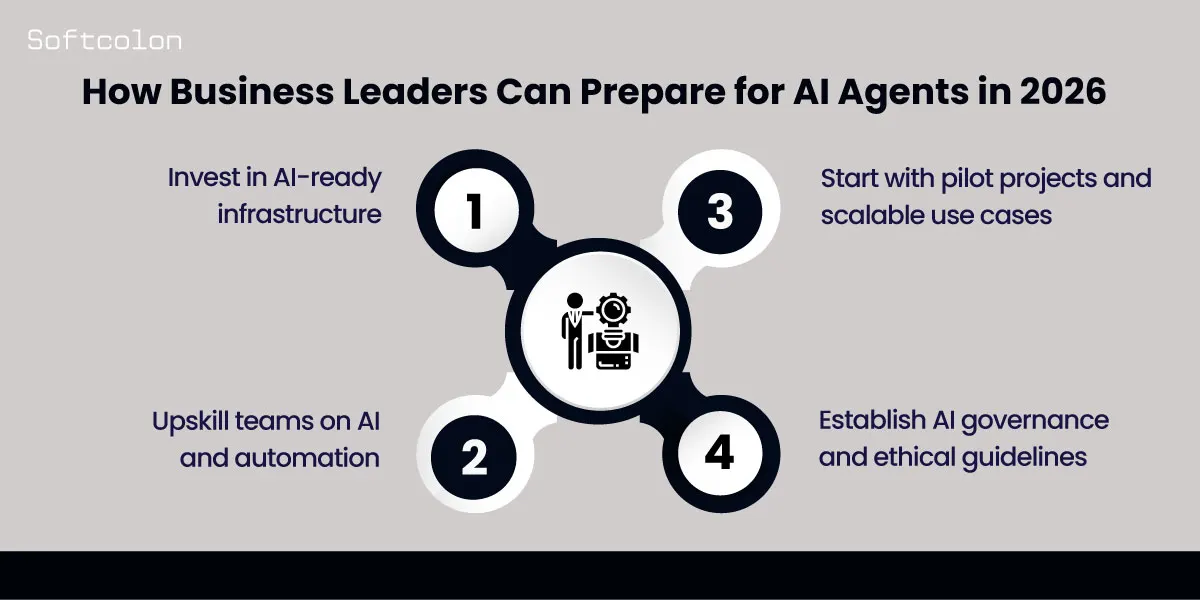
How Business Leaders Can Prepare for AI Agents in 2026
➞ Invest in AI-ready infrastructure
Business executives need to update their technological proficiency in order to properly implement the latest trends in agentic AI in 2026. This comprises real-time analytics tools, secure APIs, scalable data storage, and cloud-based platforms. For AI agents to operate efficiently, the data must be clear, organized, and easily available. Smooth integration is ensured by modernizing legacy systems and removing data silos. A solid infrastructure plan facilitates scalability, lowers deployment risks, and speeds up innovation.
➞ Upskill teams on AI and automation
Being prepared for AI involves more than simply technology; it also involves people. Upskilling initiatives that improve AI literacy at all organizational levels must be funded by leaders. While non-technical staff should learn how to work with AI systems, technical teams should expand their knowledge of automation technologies, data engineering, and machine learning. Teams may increase productivity and confidently adjust to AI-driven workflows with the support of workshops, certifications, and continuous learning efforts.
➞ Start with pilot projects and scalable use cases
Leaders should start with targeted pilot projects rather than deploying AI agents throughout the entire company at once. Businesses can verify performance and calculate return on investment by identifying low-risk, high-impact use cases, such as predictive analytics or automated customer care. Pilots that are successful increase internal confidence and offer insightful information for larger rollouts. A scalable, progressive approach ensures deliberate and sustainable AI implementation while minimizing disturbance.
➞ Establish AI governance and ethical guidelines
Clear governance structures and ethical norms are necessary for AI agent preparation. Policies for data use, accountability, openness, and bias monitoring must be established by leaders. Responsible AI deployment is ensured by the establishment of oversight committees and compliance inspections. In addition to lowering regulatory risks, ethical standards also increase stakeholder trust. Organizations build a safe, open, and long-lasting basis for long-term innovation by integrating governance into AI planning from the beginning.

Ready To Turn AI Agent Trends into Measurable Business Results?
The role of AI in chatbots and generative models undergoes a fundamental transformation, thanks to the rise of AI agents. These are the tools used for task automation, advanced planning & executing multi-step processes across diverse systems to achieve goals for an ai agent development company in india. For corporations, understanding the potential of trending AI agents is evolving into a strategic approach. AI is reshaping how organizations operate & grow.
The rising AI agent trends continue to evolve. AI capabilities are growing, driving real value for business to become a fundamental part of future organizations. By understanding the following trends discussed above, organizations can unleash their efficiency. Take help from an expert if your aim is to build an AI-ready future.