Today’s businesses function within rapid digital progress, which ties operational efficiency to their ability to achieve business growth, customer satisfaction, and financial success. Companies must deliver fast responses to customer requests while handling rising data processing needs and keeping their operations running at high standards.
Organizations across different sectors implement intelligent solutions to simplify their operations because competition among businesses keeps increasing. The growing requirement for companies to achieve operational efficiency has resulted in extensive adoption of artificial intelligence technology throughout modern business environments.
AI agents analyze data and support decision-making, and unlike traditional automation systems, they learn and improve over time. AI agents automate customer support, HR, finance, logistics, and sales, and handle workflows manually. They adapt and learn, which is valuable for building businesses.
All industries need to achieve efficient business operations because their demand keeps increasing. Recent industry research shows that nearly 60% of job roles include tasks where at least 30% of activities can be automated using existing technologies. Additional studies indicate that businesses adopting AI-driven automation may lower operational expenses by as much as 30% in specific workflows. These findings demonstrate that AI has become a widely accepted tool that businesses use to boost productivity and enhance their overall performance.
Organizations that allocate resources to digital transformation initiatives need to establish partnerships with trustworthy AI agent development service providers because this approach enables them to create operational systems that can handle growth while delivering intelligent capabilities. Organizations use AI agents to automate their repetitive work because these systems enhance customer service while reducing human mistakes and enabling quicker decision processes.
The benefits of artificial intelligence agents for organizations extend beyond their ability to automate work tasks. These intelligent systems can operate continuously, process massive amounts of information in real time, deliver personalized customer interactions, and generate valuable insights that help businesses stay competitive. AI agents are changing organizational operations by providing instant customer support and improving inventory control and workflow management functions.
This article analyzes essential advantages that AI agents provide to enhance business operations through their various applications, different methods of implementation, and upcoming capabilities.
Understanding AI Agents
➔ What Are AI Agents?
An AI agent is a software program that is capable of completing tasks, analyzing and understanding data, and making decisions that help to optimize processes, often with little to no human intervention. While traditional automation tools merely perform a sequence of actions according to a predefined routine, AI agents possess the unique ability to learn from data, respond to changes in their environment, and enhance their skills continuously.
Into the various types of AI agents, they can be classified as reactive agents, learning agents, autonomous agents, and goal-based agents.
AI agents have an enormous number of uses, such as chatbots in customer service, virtual assistants, and systems for fraud detection and prevention. By engaging an AI agent development company, you can construct a specialized AI agent that meets the requirements of your business and supports your long-term digital transformation and operational efficiency objectives.
➔ How AI Agents Work?
Artificial intelligence agents function through the application of machine learning, together with natural language processing and advanced data analytics. The systems gather data from various sources to analyze extensive datasets, which enable them to detect patterns that lead to creating intelligent solutions for business needs. The historical data and user interactions serve as learning material for AI agents to enhance their accuracy through machine learning.
For example, AI-powered customer support systems become more effective as they handle more conversations over time. AI agents provide instant assistance to decision makers by examining trends and suggesting appropriate solutions. Businesses that implement advanced AI agent development solutions experience multiple benefits of AI agents in business operations, which result in enhanced productivity, accelerated workflow processes, and improved operational accuracy.
Smart Strategies for Adopting AI and Enhancing Business Efficiency
➥ Identify Key Automation Areas
There are lots of ways to bring automation into business. Look around your business to find where delays are happening the most. Tasks like handling invoices, scheduling, manual reporting, or customer service are examples of tasks that can be automated. Breaking down delays without disrupting your business is the goal here. Finding ways to deal with the stresses on your business operations is the goal.
➥ Select the Right AI Tools
When choosing AI tools, ensure they can be tailored to your specific business needs and operational requirements. Be sure to look at the higher level of where you want your operations. For some industries, it may seem like it is the same as other industries, but it can be very important.
Organizations that partner with an experienced AI agent development agency can achieve reliable system implementation through automated process improvements, workflow efficiency enhancements, and the establishment of sustainable business growth solutions.
➥ Train Employees for AI Integration
Employee readiness plays an important role in successful AI implementation. Businesses need to conduct proper training sessions that help their teams understand how AI systems support their daily work and boost their productivity. Employees need to receive clear information about upcoming workflow changes because this will help them adopt the new processes more easily. Employees who receive proper training can operate AI systems, and their work performance reaches its peak, and all business objectives are fulfilled.
➥ Monitor and Optimize AI Performance
AI systems require ongoing monitoring to verify their capability to produce accurate results and sustain their operational performance. Businesses must conduct routine assessments of their workflow efficiency, customer service interactions, and operational enhancements to discover which components need modification. Organizations achieve better system dependability through ongoing enhancements, which enable them to meet new business demands and achieve sustained productivity gains while their AI systems continue to serve operational objectives.
Key Benefits of AI Agents for Business Processes
⇒ Increased Efficiency and Automation
⦿ Reduced Human Error
When people perform a repetitive task, they tend to make mistakes. This is a problem because it can slow down a business, result in lost money, and make customers unhappy. This process can lessen issues by AI agents performing boring business routine tasks. AI technology can be used to help with things like data input, invoicing, scheduling, reports, etc. By using AI agents, businesses can negate mental fatigue and human error when dealing with repetitive tasks.
The systems used also help with identifying operational inefficiencies and process gaps in overall systems. Businesses can focus on more efficient workflows and creative problems and decisions instead of dealing with the repetitive tasks humans used to do.
⦿ 24/7 Operations
AI agents do not need breaks like human teams and can work continuously and seamlessly. Processes are done more quickly and with better flexibility. AI systems can do customer support, manage workflows and transactions, and control all business operations. The global client base of businesses benefits from this situation.
AI agent development solutions help companies manage labor and response times with agility and ever-constant, non-stop performance. This is done even in peak high-demand situations. AI operations improve customer satisfaction for both the company and the customer. AI provides support, updates, and service without interruptions.
⇒ Cost Savings
⦿ Reduced Operational Costs
Businesses often spend significant resources managing repetitive operational tasks that require continuous manual involvement. AI agents help reduce these expenses by automating routine processes such as customer support, data processing, appointment scheduling, and invoice management. AI-driven customer service systems can handle large volumes of inquiries without requiring large call center teams, helping companies lower staffing and operational costs.
Automation helps organizations to decrease operational mistakes, which result in additional financial expenditures and project delays. The major benefits of AI agents for business lead to increased operational productivity, which results in reduced operational expenses. This enables organizations to invest their resources into developing innovative solutions while expanding their operations and enhancing their customer service.
⦿ Scalability
Manual workload management becomes more expensive and harder to maintain as businesses expand their operations. AI systems deliver scalable support by managing increased volumes of customer interactions, operational data, and business processes without needing additional infrastructure development. AI agents deliver high value to expanding businesses because they possess rapid adaptation capabilities to changing business requirements.
AI systems maintain their operational speed and accuracy during peak business times because they can handle thousands of customer inquiries and complex data analysis tasks. The system enables businesses to expand their operations while preserving service quality through reduced service delays and enhanced operational efficiency without needing to increase their staff or operational capabilities.
⇒ Enhanced Decision-Making
⦿ Data-Driven Insights
Modern businesses produce enormous quantities of operational and customer data, which creates challenges for manual analysis because it requires extensive time to complete. AI agents assist organizations with their need to analyze extensive datasets by helping them discover essential patterns that enable better business decisions. The systems possess the capability to evaluate sales results, customer movements, inventory developments, and business operations effectiveness during current business operations.
AI-driven predictive analytics enables businesses to accurately forecast future customer demand and enhance their inventory management processes while discovering new market possibilities. The primary advantage of AI business agents is that they enable companies to convert their unstructured information into operational insights, which help them boost efficiency while decreasing risks and accelerating cross-departmental decision processes.
⦿ Improved Business Strategies
Businesses use AI-driven recommendations to achieve better business results when their customers, market conditions, and work processes face unexpected changes. The AI systems continuously monitor real-time data to detect new trends, which they use to assess performance deficiencies and recommend improvements that aid business planning processes. Companies can utilize these insights to enhance their pricing strategies while increasing customer engagement and optimizing their resource allocation.
AI agents assist organizations in reaching faster decision-making processes during times of market volatility because they eliminate the need for organizations to conduct manual market analysis. Organizations can achieve better operational performance while discovering new growth opportunities through implementing quick organizational changes, which enhance their competitive advantage.
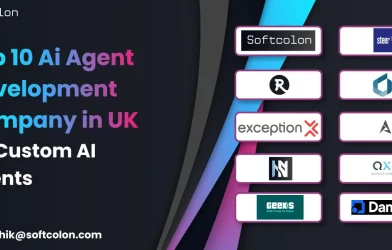
Also Read: Top 10 AI Agent Development Company in UK for Custom AI Agents
⇒ Better Customer Experience
⦿ Personalized Interactions
The current customers demand that businesses should comprehend their preferences to create personalized experiences that meet their specific needs. The AI agents of companies achieve personalized customer interactions through their ability to analyze customer browsing patterns, purchase history, and current engagement activities.
AI-powered chatbots and recommendation systems can suggest products, services, or content that closely match customer interests, creating more relevant and engaging experiences. Personalized communication strengthens brand relationships through increased customer trust.
One of the major advantages of AI agents in business is their ability to provide customized support and recommendations at scale, helping businesses improve customer satisfaction, engagement, and conversion rates across digital platforms and service channels.
⦿ Faster Response Times
Quick response times have become essential for maintaining positive customer experiences in competitive markets. AI agents help businesses respond instantly to customer inquiries without delays that result from high support volumes and limited staff availability. AI systems provide instant answers to common questions while they handle request processing, order updates, and customer support guidance.
Faster assistance improves customer satisfaction while reducing frustration from long waiting times. AI agents help businesses provide steady support quality during peak demand times and after business hours. Organizations can offer improved service experiences through multiple communication channels because continuous responsiveness establishes customer trust and enables businesses to provide consistent and efficient service.
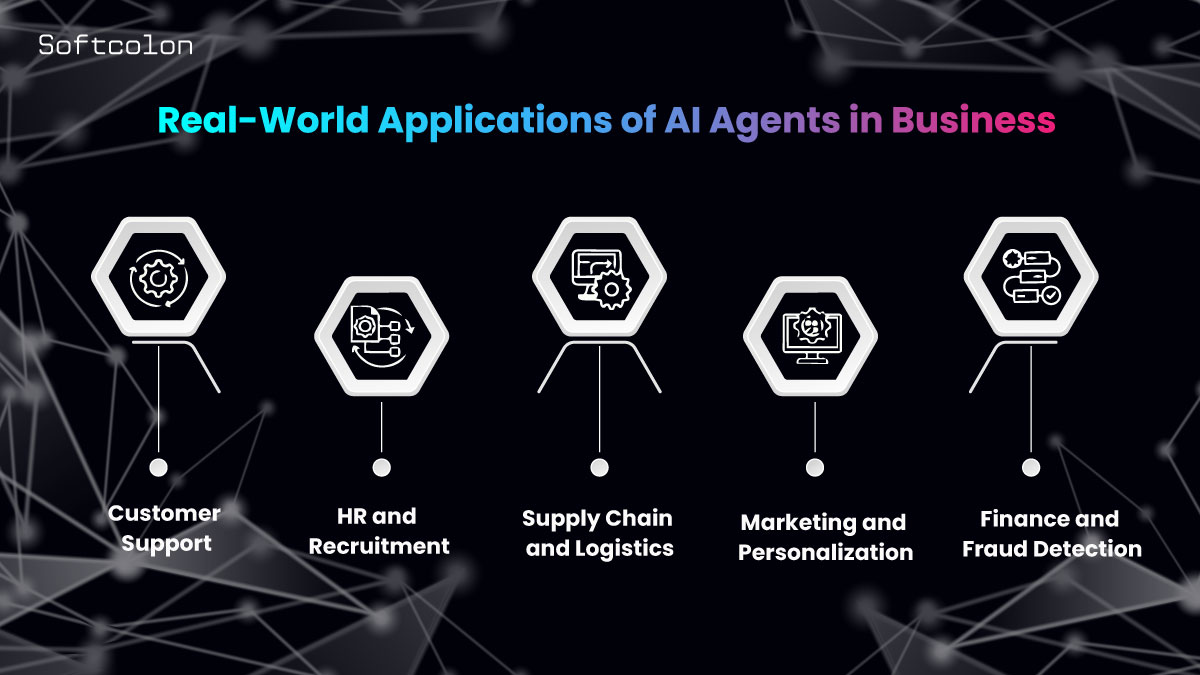
Real-World Applications of AI Agents in Business
➤ AI in Customer Support
AI agents enhance customer support by being faster, more personalized, and perpetually available. AI chatbots and virtual assistants automate customer inquiries, answer their questions, solve their issues, act on their requests, and guide them through their support processes. Companies using custom AI agent development services will be able to develop bespoke systems that best support their customers while addressing their industry’s specific requirements.
AI self-service portals give customers direct, self-service access to account details, troubleshooting guides, and automated problems. This takes the burden of support off the teams and decreases the load while increasing customers’ satisfaction, stability of their responses, and availability of services across all platforms and mediums.
➤ AI in HR and Recruitment
AI technologies are enhancing recruitment, onboarding, and employee management processes for HR teams more productively and accurately. AI-driven recruitment tools shorten recruitment cycles and lessen the manual effort spent on the recruitment process by automatically scoring applicants, leveling applicants, and ranking applicants based on defined recruitment criteria. AI tools that aid the onboarding process also prepare the framework for new employees by simplifying the management of new employees’ documents, training, and actions.
New AI tools designed for employee management also offer more advantages. The AI tools deliver employee management solutions to organizations through their capacity to track work output, employee attendance, and work performance. These systems aid in streamlining HR processes by improving the quality of HR-related decisions, which creates more efficient, effective, and scalable systems of management for businesses in HR on a growing scale.
➤ AI in Supply Chain and Logistics
Supply chain operations rely on AI agents to enhance visibility, resource management, and delay reduction. AI-enabled inventory management solutions forecast demand and maintain stock levels. Predictive maintenance identifies issues with equipment before disruptions. AI streamlines delivery in real time. AI’s abilities impact the complex logistics and route solutions, lower transportation costs, and increase delivery speed.
➤ AI in Marketing and Personalization
Advanced technologies can be leveraged in marketing to create personalized and tailored experiences for customers. They can be empowered with sophisticated AI agents, who can make smarter decisions on the kinds of campaigns to launch. Different types of AI agents can recommend products and services based on the customer’s previous purchases, presented options, and relevant suggestions.
AI agents make marketing campaigns specific to customer preferences, allow flexibility to change up the marketing campaigns to better suit customers, and significantly improve customer engagement with the marketing campaigns. The growing future of AI agents in business will develop personalized marketing methods because their intelligent data-based communication systems will help businesses better engage customers, achieve higher conversion rates, and create stronger brand relationships.
➤ AI in Finance and Fraud Detection
AI agents deployed in financial institutions enhance the processes of risk analysis, transaction monitoring, and fraud prevention. Automation systems that assess risk determine the customer’s data, financial history, and behavior patterns to enable clear and timely financial decisions.
Fraud detection tools fueled by AI continuously scrutinize transactions and detect questionable actions in real time, preventing finances from being lost. In addition, these systems foster greater regulatory obedience, help shrink investigative workloads, and bolster the fortress of financial security, all while speeding up transaction and operational efficiency.
Also Read: Best AI Agent Development Company in USA for Scalable AI Solutions
Potential Challenges of Implementing AI Agents
➢ Initial Investment and Setup
The process of implementing AI systems requires organizations to spend money on software infrastructure, system integration, employee training, and process planning. Small and mid-sized businesses find the initial costs of digital system upgrades to be overwhelming because their existing systems need complete modernization. Companies need to dedicate enough time to both workflow customization and achieving proper alignment between their operational objectives and AI technology deployment.
The experienced AI agent development agency brings its expertise to help organizations achieve better implementation results through its assistance with technical problems and project execution. Skilled AI professionals help businesses build scalable and cost-efficient solutions tailored to operational priorities, long-term growth plans, and evolving business requirements.
➢ Data Privacy and Security
AI systems require customer, operational, and financial data as their main operational data source. Businesses that lack effective security systems face dangers from both unauthorized entry and data breaches and violations of regulatory requirements. The organization needs to establish robust cybersecurity protocols, which include encryption requirements and restricted access procedures for handling confidential data.
Businesses need to show their data usage practices to customers because this transparency helps establish trust. The company must follow industry regulations to secure its AI operations on digital platforms and internal systems.
➢ Employee Adaptation
Employees initially experience uncertainty about AI adoption because they need to understand how their work processes will change with new technology, what skills they must develop, and whether their employment will remain secure. Businesses must focus on clear communication and proper training to help teams understand how AI supports daily operations rather than replacing human expertise entirely.
The implementation of AI systems in the workplace becomes more successful when organizations create an environment that supports employee collaboration with these technologies. Organizations that invest in workforce readiness programs create better transitions for their employees while helping workers acquire skills needed to succeed in digital business environments.
➢ Integration with Existing Systems
Many businesses operate using legacy software and complex operational infrastructures that may not easily connect with modern AI technologies. AI agents face technical integration difficulties because existing systems create problems with data synchronization, system compatibility, and process interruptions. Businesses require special implementation plans that enable them to integrate new systems without disrupting their existing business activities.
AI-based operational systems and digital workflow processes become more reliable and effective through organizations’ three-step development process, which requires them to design their systems properly and implement their systems through scheduled deployment methods and their technical specialists.
➢ Ongoing Maintenance and Updates
AI systems need continuous monitoring, periodic updates, and performance optimization to achieve their required performance standards and operational efficiency throughout their lifetime. Businesses must regularly review system outputs, update datasets, improve algorithms, and address evolving business requirements. The AI systems will deliver decreasing effectiveness, together with outdated results, when organizations stop their maintenance activities.
Organizations need to create long-term support systems that will monitor performance, security updates, and system enhancements to maintain AI technologies that deliver dependable value throughout changing operational requirements and market developments.
Ready to Transform Your Business? Let AI Lead the Way
AI agents help businesses improve operational efficiency, reduce manual workloads, increase customer satisfaction, and enable organizations to make decisions faster through their intelligent automation capabilities. AI-driven systems now streamline complex workflows for customer support, marketing, logistics, and finance, which enables organizations to achieve better scalability and productivity. Businesses that implement current AI technologies create operational systems that can quickly adjust to new customer needs and market competition. This can help businesses keep the performance consistent and optimize the use of resources within departments.
The implementation of AI systems requires organizations to spend money on initial setup costs, while they also need to train their employees and handle system integration hurdles. Businesses that invest strategically in intelligent automation can reduce operational costs while also enhancing workflow accuracy and building their capacity to expand. Organizations achieve sustainable growth through customized solutions, which an experienced AI agent development company provides to support their digital transformation projects while maintaining operational and technical stability.
The future of AI Agent Development will continue transforming business operations through its capabilities in customer management and strategic business planning. Industrial organizations are developing artificial intelligence systems that demonstrate increased intelligence and adaptability through their ability to process more intricate operational tasks.
Organizations that use AI to improve their processes will achieve better innovation results while their operations become more adaptable and they establish ongoing market dominance in today’s data-driven business landscape. The change will create new methods that companies will use to create their international business paths and build their teams.