Intelligent technology is becoming a key factor in helping companies to become more productive, cutting down the operational costs, and at the same time giving a better service to the clients. The increasing need for AI agent development Service and the widespread use of enterprise AI agents in various sectors have significantly contributed to the market growth.
Simply relying on traditional automation methods will not suffice when it comes to complex workflows, rapidly changing business environments, and making decisions on the fly. In fact, Deloitte’s 2026 State of AI report found that 74% of organizations plan to deploy agentic AI across multiple business functions within the next two years, reflecting the growing demand for intelligent and adaptive automation. The development of modern AI agents allows businesses not only to automate their processes in a smart way but also to increase efficiency, scalability, and business agility.
Companies are turning to AI-based automation at a higher rate to get their operation done in a more streamlined way, enhance customer service, make the best use of their decision-making capabilities, and at the same time obtain a competitive advantage in the ever-changing digital market.
What Are Enterprise AI Agents?
Enterprise AI agents are smart computer programs that perform a variety of tasks independently by using artificial intelligence. These agents work differently from the traditional automation software that follows preset rules; enterprise AI agents are capable of comprehending the content, making a judgment, learning from the data, and even changing their behavior in accordance with the new business environment.
Enterprise AI agents are finding their feet very quickly, and businesses are attracted to them for flexible and smart automation solutions not only for customer service, but also for operations, IT management, sales, and data analysis.
❖ Defining AI Agents
Artificial intelligence (AI) agents are autonomous systems that apply AI methods, including machine learning, natural language processing (NLP), and predictive analytics. Without human assistance, they are capable of data analysis, task reasoning, and action execution.
In contrast to simple automation, AI agents are able to work with ambiguous information, understand what the user means, and learn how to do better over time. This is why they are so suitable for today’s enterprise environments, where business processes are continuously evolving.
Thanks to the considerable rise in intelligent automation in industries, the world is seeing a boom in demand for AI agent development service providers.
❖ How Enterprise AI Agents Work
Enterprise AI agents utilize a combination of natural language processing (NLP), machine learning algorithms, workflow automation, and contextual comprehension. These features enable agents to grasp conversations, perform data analysis, and accomplish business tasks in several steps all on their own.
They not only work with enterprise software but also handle unstructured data, come up with suggestions, and streamline complex workflows. It is quite common these days for businesses to take the help of an AI agent development agency for the implementation of AI-driven automation in their routine operations.
❖ Examples of Enterprise AI Agents
➤ Typical instances of workplace AI agents include the following:
➥ Customer support AI assistants
➥ AI-enabled sales representatives
➥ IT service desk agents
➥ HR automation agents
➥ Operations management agents
These smart systems are becoming the key elements of most organizations’ journeys to the digital transformation that meets their modern-day needs.
Enterprise AI Agents vs Traditional Automation: Key Differences
Business executives need to recognize the gap between traditional automation and enterprise AI agents when making decisions about automation investments for the future.
Whereas traditional automation relies on narrowly defined workflows and limited types of repetitive tasks, enterprise AI agents offer intelligent decision-making, flexibility, and the ability to learn in real-time.
◈ Decision-Making Capabilities
Traditional automation systems adhere strictly to set rules and predetermined workflows. They only carry out tasks that have been explicitly programmed and find themselves at a loss when unexpected situations arise.
On the other hand, enterprise AI agents employ intelligent deduction and contextual analysis to decide on a course of action on the spot. They are capable of changing tack according to the business scene and handling intricate workflows without human assistance.
This distinction explains why a number of enterprises are on the lookout for the best-rated enterprise AI agents for their sophisticated operational needs.
◈ Adaptability and Learning
The traditional automation systems are based on fixed workflows that need to be manually updated every time business processes change. They do not have the capability to learn from experience or to automatically optimize workflows.
Enterprise AI agents, conversely, are always learning from human engagements, business data, and patterns of operation. Their adaptability and capability to better themselves with time enable businesses to be agile in fast-moving markets.
Several companies, at present, are collaborating with custom AI agent development companies to build AI systems that can change and grow according to business demands.
◈ Data Processing and Insights
Traditional automation mainly deals with structured data, which comes from forms, spreadsheets, and databases. It has a hard time processing emails, conversations, documents, and other types of unstructured information.
Enterprise AI agents have the capability to process both types of data in real-time. They help businesses make decisions automatically and also carry out predictive analysis.
Undoubtedly, this makes the leading companies for enterprise AI agents quite valuable to data-centric organizations.
◈ User Interaction Experience
Traditional automation tools offer scripted and fairly basic interactions with users. Such systems are quite likely to crash when conversations get complicated or when the context changes.
Enterprise AI agents make use of NLP for conversation and provide interaction that is contextually aware. They are able to figure out the intention of the customer, supply personalized replies, and as a result deliver better engagement experiences.
There is a growing number of enterprises that prefer the best enterprise AI agent services for conversational AI automation because of their desire to deliver superior customer experiences.
◈ Scalability and Flexibility
Traditional automation solutions are often limited when companies want to expand their operations to multiple departments and workflows.
Enterprise AI agents are the ones providing the flexibility for green-wide automation to support complex workflows, multi-system integrations, and intelligent task management. It is this scalability that makes them the right choice for today’s digital businesses.
Also Read: AI Agent Development Cost in 2026: Complete Pricing Guide for Businesses
Benefits of Enterprise AI Agents for Modern Businesses
There are several advantages that enterprises can gain by using AI agents, such as operational speed, accuracy, and scalability. AI agent development solutions of today allow enterprises to handle highly complicated workflows with the help of automation.
✦ Increased Operational Efficiency
Enterprise AI agents can do away with manual work by automating repetitive and time-consuming activities. These smart systems are capable of handling heavy work with ease and at the same time, reducing errors and raising performance levels.
⇒ Major positive outcomes:
• Rapid completion of workflows
• Lower operational costs
• Increase in the accuracy of processes
• Better utilization of resources
By employing sophisticated AI agent development service providers, companies are in a position to greatly enhance their performance and efficiency of workflows.
⇒ Improved Decision-Making
AI agents scrutinize vast amounts of business data and come up with smart recommendations for better decision-making. Forecasting that is based on these insights assists organizations in identifying their risks and opportunities and then excelling in their planning activities.
⇒ Users of enterprise AI agents consulting could expect the following benefits:
• Recommendations based on data
• Insight into business operations in real-time
• Increased forecasting precision
• Enhanced decision-making capabilities in operations
⇒ Enhanced Customer Experiences
Enterprise AI agents enable companies to better interact with their customers through one-to-one communication and rapid responding. These systems are capable of grasping the purpose of the user, helping solve issues in a short time, and providing customers with the same support experience across all channels.
⇒ The best company for enterprise AI agents can:
• Customer satisfaction
• Increase in response time
• Personalized support
• Consistency
✦ Greater Business Agility
AI-supported automation enables companies to swiftly react to evolving market scenarios, the requirements of customers, and internal challenges. Intelligent automation is, in fact, one of the main pillars for continued innovation and growth.
⇒ Entities partnering up with a highly effective AI agent development agency have the ability to:
• Develop automation strategies that can be scaled up
• Quickly adjust to shifting business circumstances
• Become more adaptable in their methods of operation
• Have better support for their efforts at innovation
Where Traditional Automation Still Delivers Value
Although AI agents for enterprise are capable of dramatically more than traditional automation, the latter remains a worthy tool for many businesses. Simple, rule-based automation is a good fit for very repetitive and highly predictable processes with a low level of complexity. Common examples of uses are data entry, invoice processing, payroll management, and report generation.
Furthermore, traditional automation is generally simpler and less costly to roll out when compared with sophisticated AI-based solutions. It helps businesses decrease manual tasks, boost precision, and raise the efficiency of operations that are quite fixed and repetitive in nature.
⇒ Limitations Business Leaders Should Consider
There are a number of downsides of traditional automation systems that companies need to be aware of if they want to design an expanded automation strategy. Primarily, these systems rely heavily on predefined rules and fixed workflows, which makes them less capable of adapting to dynamic business settings and complex operational scenarios.
Moreover, traditional automation is not well equipped for handling exceptions, unstructured data, and contextual understanding. In stark contrast, enterprise AI agents can learn from experiences and improve themselves automatically over time.
With the increase in the pace of changes in business operations, many enterprises are looking at AI agent development and AI adoption among enterprises to realize flexibility, scalability, and effectiveness of automation in their businesses.
Enterprise AI Agents Use Cases Across Industries
Across the board, enterprises are turning to enterprise AI agents to automate their workflows, enhance their efficiency, and create improved customer experiences. They are engaging with recognized AI agent development service providers to deploy scalable, productive, and rapid decision-making capability-enabled intelligent automation solutions.
✧ Financial Services
Financial companies are utilizing enterprise AI agents to enhance fraud detection, automate customer service, and fortify their risk analysis processes. AI-based systems have the capability to systematically analyze substantial quantities of financial data for detecting irregularities and counteracting fraud.
Besides that, banks and financial firms are leveraging AI agents for transaction monitoring, regulatory compliance, financial planning, and automation of the customer service process. These intelligent entities contribute to streamlining operations and cutting down on manual efforts, thus facilitating quicker financial decision-making.
✧ Healthcare
Healthcare providers are increasingly using enterprise AI agents to handle patient support services, appointment scheduling, and clinical workflow management. These AI-powered healthcare solutions not only sustain patients’ experiences but also help alleviate the challenge of mounting administrative tasks faced by healthcare staff.
AI agents are utilized for medical data processing, patient communication, and workflow organization. Additionally, these intelligent solutions help healthcare professionals improve overall healthcare service delivery, patient engagement, and operational efficiency.
✧ Manufacturing
Manufacturing firms employ enterprise AI agents to assist them in predictive maintenance, inventory planning, production checking, and supply chain capabilities optimization. Automation through artificial intelligence has led to manufacturers being able to detect faults in machinery even before breakdowns happen, thereby reducing downtime and maintenance expenses.
Besides, enterprise AI agents optimize operations planning by studying production data, keeping track of inventory levels, and optimizing logistics procedures. Here, the manufacturer stands to gain enhancements in productivity, a reduction of delays, and an overall improvement of operational effectiveness.
✧ Retail and E-commerce
Retail and e-commerce companies rely on AI agents to offer personalized product suggestions, automate customer support, forecast inventory, and manage orders. AI-driven systems examine customers’ actions and buying patterns to give them a much more personalized shopping experience.
Today’s enterprise AI agents enable retail outlets to not only engage with customers more effectively but also to support their customer service teams in automating and optimizing the supply chain. These intelligent capabilities also help in hastening response times and lead to a greater level of customer satisfaction overall.
✧ Technology and SaaS
Technology and SaaS sectors are turning to enterprise AI agents to automate IT help services, manage workflows, keep track of knowledge, and enhance internal procedures. AI agents contribute significantly to automating monotonous IT activities, solving support requests swiftly, and raising the level of workforce performance.
Companies are increasingly turning to leading companies for enterprise AI agents to help develop enterprise systems driven by AI at scale. These smart solutions are assisting tech businesses in enhancing their efficiency in operations, decreasing costs of support, and hastening the implementation of digital transformation initiatives.
Also Read: The Key Benefits of AI Agents for Streamlining Business Processes
How to Determine What Your Business Needs
Deciding between conventional automation and enterprise AI agents fundamentally hinges upon desired business outcomes, level of workflow intricacy, scale potential, and type of operational challenges. Companies thoroughly review their current activities and automation maturity prior to the procurement of intelligent automation technologies.
Workflows characterized by repetition and rules might find traditional automation more fitting; however, enterprise AI agents could prove indispensable to organizations dealing with fluid processes, immediate decision-making, and processing of unstructured data.
➨ Questions Business Leaders Should Ask
To reap the full benefits of intelligent automation, business leaders must first take a good look at what they actually need and where they are planning to go in the long run. Coming up with the right questions is a big part of the puzzle when it comes to figuring out whether enterprise AI agents tie in well with their automation strategy.
⦿ Some of the major questions include:
➣ Which processes are the most complex and require human-like intelligence?
➣ Are the workflows manual and repetitive or dynamic?
➣ What level of scalability is necessary?
➣ Does the business deal with vast amounts of unorganized data?
By answering such queries, companies gain insight into which areas will benefit the most from AI-enabled automation.
➨ Signs You Need Enterprise AI Agents
Companies experience the necessity for enterprise AI agents when their traditional automation solutions fail to cope with increasing workflow complexity or changing conditions of running the business. Those with large data handling and multifarious processes will usually gain the most by deploying AI-driven automation.
◉ Typical indications include:
➣ Requirements for complex decision-making
➣ Extensive unstructured data
➣ Real-time insight demands
➣ Ongoing problems with workflow optimization
Choosing to work with a proven custom AI agent development firm allows companies to craft highly scalable AI solutions aligned with their processes, operational needs, and their long-term business objectives.
Can Enterprise AI Agents and Traditional Automation Work Together?
It is quite common for firms to merge traditional automation with AI systems to produce hybrid intelligent automation environments. Rather than switching their automation systems entirely, companies are putting enterprise AI agents in conjunction with rule-based working processes to enhance operational efficiency, scalability, and decision-making capabilities.
Such a hybrid solution enables companies to get the best out of their existing automation assets while progressively introducing inbuilt features like contextual awareness, predictive analytics, and decision-making in real time. Usually, businesses collaborate with a proficient AI agent development agency to integrate AI agents into the current enterprise system and workflows successfully.
➞ The Hybrid Automation Model
In a hybrid automation approach, traditional rule-based automation is joined by enterprise AI agents that act as intelligent components capable of running entire business automation chains. Here, conventional automation is in charge of monotonous, repetitive, and predictable tasks, whereas enterprise AI agents command complex work processes, dynamic decisions, and contextual interactions.
An invoice or database update automated by conventional automation is an example of a basic operation, while AI agents could be analyzing customer queries, producing recommendations, or dealing with exceptions that require intelligent judgment. Both strategies, when used together, allow enterprises to enhance both the speed of operations and the level of automation intelligence.
➞ Business Benefits of a Hybrid Approach
Companies embracing hybrid automation strategies enjoy, first and foremost, improved operational efficiency by significantly decreasing manual workloads and facilitating faster workflow execution.
Introducing AI agents to handle complex decisions and exceptions should further lead to high accuracy in automation. Besides, organizations could expect better scalability, more rapid process execution, and enhanced customer experiences owing to more intelligent and responsive automation systems.
In this way, businesses are able to modernize their practices without having to discard the whole existing automation infrastructure, rendering the adoption of intelligent automation more feasible and economically viable.
Key Considerations Before Implementing Enterprise AI Agents
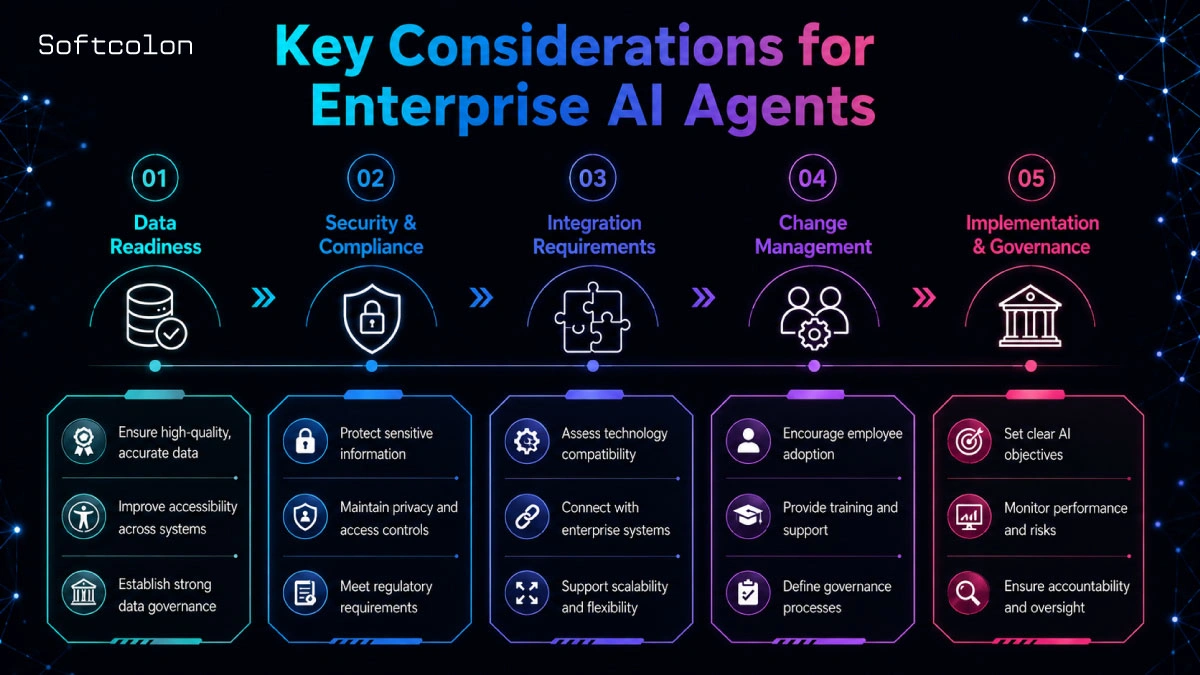
Implementing enterprise AI agents calls for a preparatory review of the technical foundation, governance policies, and workforce strategies in order to successfully adopt AI solutions. Aside from technical specifications, operational challenges, compliance, and business objectives also need to be considered thoroughly before deploying such systems.
There is no doubt that detailed planning coupled with strong governance and alignment of business operations with technological capabilities makes up an ideal recipe for going forward with AI systems. Besides, organizations should check whether their current setup is sufficient for the needs arising from the enterprise AI implementation.
◈ Data Readiness
High-quality, well-organized, well-governed, and easily available data is the backbone on which successful AI systems stand. Enterprises must assess their data for accuracy, consistency, security, and organization before integrating AI-driven automation.
When working with AI, the difference that good data quality makes is huge, and getting it wrong can not only degrade AI performance but also result in inaccurate or unreliable automated outcomes. Hence, there is a need to have in place appropriate data governance frameworks and ensure data accessibility across the enterprise.
◈ Security and Compliance
Enterprise AI systems, like any other IT systems, have to adhere to the relevant industry regulations, privacy laws, and corporate security standards. For those businesses managing sensitive customer or operational data, the implementation of robust security measures should be a priority to effectively safeguard data and minimize phishing risks of AI applications.
In addition, businesses should develop and implement governance policies regarding AI implementation, monitoring, and risk management. The establishment of rigorous compliance frameworks will ensure that the organizations continue to enjoy the trust of their stakeholders, enhanced transparency, and regulatory compliance during the evolution of AI.
◈ Integration Requirements
For a smooth transition and less disruption, organizations need to examine closely how well enterprise AI agents will fit in with the existing software platforms, enterprise systems, and operational workflows. Working seamlessly together with an organization’s ERP systems, CRM platforms, cloud infrastructure, databases, and internal applications is a key success factor in the deployment of enterprise AI agents.
Evaluation of integration options will assist businesses in making their workflows more efficient, limiting interruptions, and making good use of intelligent automation investments.
◈ Change Management
Adopting AI involves more than just updating software. It also entails preparing the workforce, business processes, and operations for intelligent automation. The role that employee education, leadership endorsement, and process modifications play cannot be overstated.
Setting up clear governance structures along with offering training are two ways to help the workforce familiarize themselves and understand how AI technologies will be of help in their daily work. With this, change management strategies will result not only in enhanced employee readiness but will also pave the way for a smoother enterprise AI experience.
Future of Enterprise Automation
The pace at which enterprise automation is changing is quite remarkable, thanks to artificial intelligence, machine learning, and smart orchestration of workflows. Most companies are determined to move beyond basic rule-based automation and invest in intelligent systems capable of examining data, making decisions, and automating complex operations instantaneously.
Future automation will revolve largely around self-governing systems, AI-endowed decision-making, and intelligent digital labor forces that substantially increase operational efficiency and business agility. Digital transformation and competitive development are just some of the areas where companies employing enterprise AI technologies will be reaping benefits.
⇒ Emerging AI Agent Trends
The destiny of enterprise AI agents and intelligent automation is being molded by a number of the latest trends. Companies are opting more and more for multi-agent systems where a number of AI agents work together to accomplish complex tasks more effectively.
Autonomous business operations have also been gaining ground following the rise of AI systems capable of running processes with minimal human input. Other key trends entail AI-enabled decision intelligence, automation that is context-sensitive, and workflow orchestration that lead to improvements in speed, accuracy, and scalability.
Early adoption of best-rated enterprise AI agents is set to bring about notable competitive advantages in the long run through enhanced efficiency and more intelligent automation.
⇒ What Business Leaders Should Expect
Business leadership might look forward to greater enterprise AI acceptance as organizations will continue to put their focus and funds toward intelligent automation technologies. Such AI-enabled systems will evolve to become more scalable, flexible, and capable of managing multi-departmental and industry-wide complex business operations.
Besides that, there will be an emergence of AI-powered digital workforces that aid productivity and innovation, which, together with smarter operational decision-making and workflow automation, will form the key milestones of this transformation journey. Enterprises investing in the best enterprise AI agents and intelligent automation strategies will not only survive but thrive in this new digital economy.
Ready to Transform Your Business with Enterprise AI Agents?
Enterprise AI agents provide the possibility of changing how business automation works by giving it a brain and an ability to adapt to the earthquakes of real-time. Those businesses that decide to invest in high-level AI agent development solutions stand to gain from greater efficiency, experience improvements for customers, and operational scalability enhancements.
Joining hands with a reputed custom AI agent development company or an enterprise AI agents consulting company equips enterprises with intelligent automation systems that are ready for the future.