The rate of AI adoption is increasing in the business landscape. Based on the reports of Stanford, 78% of firms integrated AI in 2024, and 92% of firms are looking forward to using AI in the next few years. Every business, along with your competitors, unleashes the power of AI. So, there is a risk of falling behind if you don’t use AI. AI development services help to streamline your operations, make smart decisions, and automate processes. From AI agents to predictive analytics, firms are embedding AI into crucial workflows to drive efficiency and user engagement.
The AI development steps are an organized practice that assists in making a decision. The development process by an AI development company involves planning, data engineering, model deployment, and ongoing optimization. AI development services are a structured methodology that assists in analyzing data, recognizing patterns, and making predictions. In 2026, firms are increasingly focused on turning their AI models scalable, reliable, and simple to update. Owing to a strategic development & deployment framework, measure whether it serves sustained business value.
This guide talks about how AI development really works and the AI development process steps. From strategic planning to cost structures, real-world use cases, challenges & ways to overcome, it covers everything. Whether you are launching your first project or scaling a multi-team AI deployment, the insights we have mentioned in the blog will help you.
Defining the Problem and Business Objectives
➔ Identifying the Right Use Case
The selection of the best AI use case by an AI development agency is crucial to achieving valuable business outcomes. Businesses must align AI initiatives with clearly defined business goals like enhancing efficiency, limiting cost, and driving customer experience. High-impact use cases mostly cover automation of repetitive tasks, predictive analytics for measuring trends, and customization to enhance user engagement. By monitoring complexities that deliver measurable values, organizations can avoid unnecessary complexity & ensure faster ROI. The well-defined use case supports prioritizing resources, selecting ideal tools, and setting a strong foundation for successful AI implementation.
➔ Stakeholder Alignment
Successful AI initiatives demand strong alignment among all stakeholders, involving leadership, the technical team & organization users. Collaboration of both technical & non-technical stakeholders ensures that the solution is usable & aligned with the real-business demands. Clear communication also helps define expectations, outcomes, and timelines while limiting misunderstanding.
To design a shared vision of success, establish success criteria like performance metrics, cost savings, and efficiency gains. Frequent collaboration & feedback loop are necessary to keep everyone aligned throughout the SDLC. It ensures that the AI solutions deliver value and are adopted effectively across the business.
➔ Feasibility Assessment
Before AI implementation, businesses must conduct a thorough feasibility assessment to determine whether the initiative is sustainable and practical. It includes measuring data availability, relevance & quality as AI models rely mostly on accurate & sufficient data. Organizations should also measure the cost of development & deployment & maintenance against expected ROI.
In addition, technical constraints like infrastructure, integration capabilities, and skill accessibility must be considered. The comprehensive feasibility analysis identifies risk early, optimizes the resource allocation, and verifies that AI solutions are both technically & financially viable.
Building Scalable AI Systems: From Data to Optimization
⇒ Data Collection and Preparation
✧ Data Sources
An effective AI development process relies on diverse & quality data sources to deliver scalable & accurate outcomes. Businesses must combine internal data like CRM records, app logs & transactional data with external sources such as APIs, 3rd party providers, and public datasets. The combination enriches insights & drive model performance by offering broader contexts.
The reliable AI development agency supports identification, integrates & manages these data streams effectively. Ensure proper data governance, compliance & security are necessary when managing various sources. The well-designed data sourcing approaches allow businesses to build robust AI models that scale effectively across various organizational functions & use cases.
✧ Data Cleaning and Preprocessing
Data cleaning & preprocessing are necessary to ensure the AI model produces reliable & unbiased outcomes. Raw information mostly covers missing values, inconsistencies, and duplicates, which must be addressed prior to training. Techniques like managing missing values through imputation, normalization for consistent scaling & customization for feature optimization for model accuracy.
Removal of inconsistencies and bias is crucial to avoid prediction and ensure fairness. Complete preprocessing drives data quality & minimizes noise. It allows algorithms to learn valuable patterns. The structured approaches by a custom AI development company enhance the scalability and performance of AI systems.
✧ Data Labeling and Annotation
Data labeling and annotation play a strong role in training AI models, mostly in supervised learning scenarios. Based on the use case, the organization must evaluate whether supervised or unsupervised practices are more suitable. Supervised models demand accurate labeling datasets, mostly designed through human-in-the-loop processes to verify precision & context understanding.
Annotation tools in the best AI development services support streamlining the process by allowing effective image tagging, text, and audio data. Managing consistency & quality during labeling is necessary for opting for high-performing models. The well-annotated datasets’ impact on the model accuracy makes the step necessary for designing reliable & scalable AI systems that deliver valuable business outcomes.
⇒ Model Selection and Development
⦿ Choosing the Right Approach
✧ Traditional ML vs. deep learning vs. generative AI
With its quicker training and simpler interpretability, traditional machine learning is perfect for structured datasets and applications like forecasting, regression, and classification. Deep learning, a branch of machine learning, uses neural networks to interpret unstructured input, including text, speech, and images, but it needs more processing power and large datasets.
By producing original content, such as text, pictures, or code, generative AI goes one step further and is useful for automated and creative applications. The complexity of the data, the necessity for scalability and accuracy, and the particular business issue that needs to be successfully solved all play a role in the decision between various methods.
✧ Build vs. buy (pretrained APIs vs. custom models)
Timeliness, resources, and business priorities all play a role in the decision to develop or purchase AI solutions. Pretrained APIs are affordable for common use cases like chatbots and image recognition because they enable businesses to swiftly implement AI capabilities with little development work. They might not, however, allow for customization or control over the behavior of the model.
Custom models, on the other hand, are made to meet particular business requirements. They provide greater accuracy and flexibility but necessitate a large infrastructure, data, and skill investment. To select a system that successfully strikes a balance between speed, cost, and performance, businesses must consider aspects like scalability, maintenance, and long-term ROI.
✧ Model Training
The process of educating an AI model to identify links and patterns in data is known as model training. It entails utilizing structured training pipelines to guarantee consistency and scalability, employing feature engineering to enhance input quality, and feeding prepared datasets into algorithms. By modifying important learning parameters, hyperparameter tuning is used to maximize performance.
Models are verified throughout training in order to track correctness and avoid mistakes. Effective generalization of the model to fresh data is ensured by a well-conducted training procedure. Building dependable, high-performing AI development solutions that provide precise and useful insights for business decision-making requires this stage.
✧ Evaluation Metrics
Evaluation metrics are used by leading AI development companies to assess an AI model’s performance and whether it achieves business goals. A few metrics that support predictions are accuracy, precision, and F1 score. These indicators are useful for evaluating performance, particularly when dealing with imbalanced datasets.
Beyond technical metrics, real-world value and effect are ensured by matching results with business-specific KPIs. Comparing training and validation results is another crucial way to keep an eye out for overfitting. Organizations can enhance models, increase dependability, and guarantee that AI solutions provide consistent and significant results by using the appropriate evaluation framework.
Also Read: List of AI Agent Development Services to Build Custom AI Agents
⇒ Infrastructure and Scalability Planning
⦿ Cloud vs. On-Premise
The selection between cloud & on-premise infrastructure is a crucial decision for a scalable AI system. The custom AI development service providers use them to offer managed AI services that accelerate deployment and scaling. They limit upfront investment & enable organizations to pay based on usage. The on-premise infrastructure offers better control over data, compliance, and security, necessary for highly-regulated industries.
However, it demands significant capital investment & ongoing maintenance. Business must determine cost & performance trade-offs, cover latency, scalability, and workload variability. Cloud environments are ideal for dynamic & rising workloads, whereas an on-premise setup may suit predictable and stable operation. The hybrid approach is also popular, combining the benefits of both models to balance cost, scalability, and control.
⦿ MLOps Foundations
MLOps design the backbone of managing, deploying & maintaining ML systems at scale. It integrates best practices from DevOps to verify smooth collaboration between data scientists, engineers & organization team. The key components involve version control of both datasets & models, allowing traceability and reproducibility across experiments. Integrating CI/CD pipeline for ML to automate testing, deployment, and update verification to deliver faster & reliable releases.
The skilled AI development business often establishes robust MLOps frameworks to streamline workflows & minimize operational risks. The experiment tracking tools used by an AI development company additionally support tracking model performance, comparing results, and making document improvements over time. Together, these practices drive efficiency, limit errors, and ensure that AI systems remain scalable, consistent, and aligned with changing organizational needs.
⦿ Scalability Considerations
For AI systems to be able to manage growing data volumes, user demands, and changing workloads, scalability is crucial. Selecting between batch and real-time inference is an important factor. While inference in real time facilitates immediate decision-making for applications like fraud detection or recommendations, batch processing is appropriate for large-scale, non-time-sensitive operations.
Another important component is load balancing, which divides incoming requests among several servers to preserve system speed and avoid overload. Additionally, by utilizing distributed systems, businesses can increase efficiency and speed by processing data and training models across several nodes.
Consistent performance, lower latency, and cost optimization are guaranteed by effective scalability planning. Businesses can retain dependability and provide top-notch AI-driven experiences even as demand and complexity rise over time by creating systems that can expand with ease.
⇒ Deployment and Integration
⦿ Deployment Strategies
The effective and safe introduction of AI models into production systems is determined by deployment strategies. Depending on latency and use case requirements, common methods include edge deployment, real-time API-based deployment, and batch deployment. By implementing changes gradually and keeping an eye on performance prior to full release, blue-green and canary deployments help reduce risks.
Scalability and consistency across environments are further improved by containerization and orchestration solutions. Faster releases, fewer downtimes, and flawless user experiences are all guaranteed by a carefully thought-out deployment strategy. Additionally, it enables teams to swiftly undo modifications in the event of problems, guaranteeing stability and dependability in production systems.
⦿ Integration with Existing Systems
Delivering genuine corporate benefit requires integrating AI models with current platforms. This entails using middleware and APIs to link models to applications like CRM platforms, ERP systems, or customer-facing interfaces. AI insights are incorporated into routine processes through seamless integration, which enhances productivity and decision-making.
To prevent interruptions, compatibility, data flow, and security must be properly controlled. Automation of corporate operations and real-time data transmission are also made possible by proper integration. Organizations can maximize adoption, minimize operational friction, and guarantee that AI capabilities improve rather than complicate present systems by integrating AI solutions with current infrastructure.
⦿ Monitoring and Logging
For AI systems to remain reliable and operate well in production, monitoring and logging are crucial. In order to identify problems like model drift or unexpected behavior, continuous monitoring keeps track of model correctness, latency, and system health. Troubleshooting and auditing are made possible by logging, which records inputs, outputs, and system actions in great detail.
These procedures guarantee regulatory compliance while assisting teams in monitoring & addressing errors. Proactive maintenance is also supported by effective monitoring, which shows performance patterns over time. Monitoring and logging work together to sustain high-quality AI performance in dynamic contexts, increase system stability, and guarantee transparency.
⇒ Testing and Validation
⦿ Model Testing
Before AI systems are deployed, model testing guarantees their accuracy and dependability. It entails assessing models on test and validation datasets to gauge performance in a range of situations. Strategies like edge case analysis, stress testing, and cross-validation aid in locating flaws and enhancing robustness.
Organizations can verify if the model satisfies technical and business objectives by recreating real-world scenarios. Extensive testing ensures that AI systems produce reliable and consistent results by lowering the possibility of production errors and boosting stakeholder confidence.
⦿ Ethical and Compliance Checks
To make sure AI systems behave properly and follow the law, ethical and compliance checks are essential. To avoid prejudice or unintentional harm, this involves assessing models for bias, fairness, and transparency. Verification of adherence to industry standards and data protection legislation is also necessary, particularly when managing sensitive data.
Accountability and regulatory scrutiny depend on documentation and audit trails. Clear ethical standards and governance frameworks for the use of AI should be established by organizations. Businesses can establish trust, safeguard their brand, and make sure that AI solutions comply with legal standards and society norms by giving ethical issues top priority.
⇒ Continuous Improvement and Maintenance
⦿ Model Retraining
As data and business contexts change, model retraining is required to maintain the accuracy and relevance of AI systems. Retraining with updated datasets on a regular basis assists in accuracy maintenance and trend adaptation. Performance thresholds or scheduled pipelines can be used to automate this procedure.
Additionally, the custom AI development process offers chances to enhance model capabilities and add new features. Organizations may guarantee long-term dependability, improved decision-making, and ongoing value from their AI investments by regularly updating their models.
⦿ Feedback Loops
By integrating real-world data and human interactions into AI systems, feedback loops facilitate ongoing learning and development. To improve algorithms over time, they gather information from user behavior, system performance, and model forecasts. This procedure helps in error detection, accuracy enhancement, and condition adaptation.
Automating feedback loops can guarantee prompt updates and responses. Additionally, they encourage cooperation between developers and users, guaranteeing that the system adapts to real-world requirements. Organizations can maintain alignment with business objectives and improve model performance by appropriately utilizing feedback.
⦿ Performance Optimization
Enhancing AI systems’ efficiency, speed, and scalability is the result of performance optimization. This involves optimizing resource use, cutting latency, and improving algorithms. Performance can be improved without sacrificing accuracy by using strategies like hardware acceleration, pruning, and model compression. Finding bottlenecks and potential improvement areas is made easier with ongoing monitoring.
In order to guarantee effective operations, optimization also entails striking a balance between cost and performance. Organizations can manage increased workloads, provide quicker responses, and maintain a smooth user experience by routinely optimizing models and infrastructure. This ensures that AI systems continue to be efficient and competitive over time.
Also Read: Best AI Agent Development Company in USA for Scalable AI Solutions
Common Challenges and How to Overcome Them
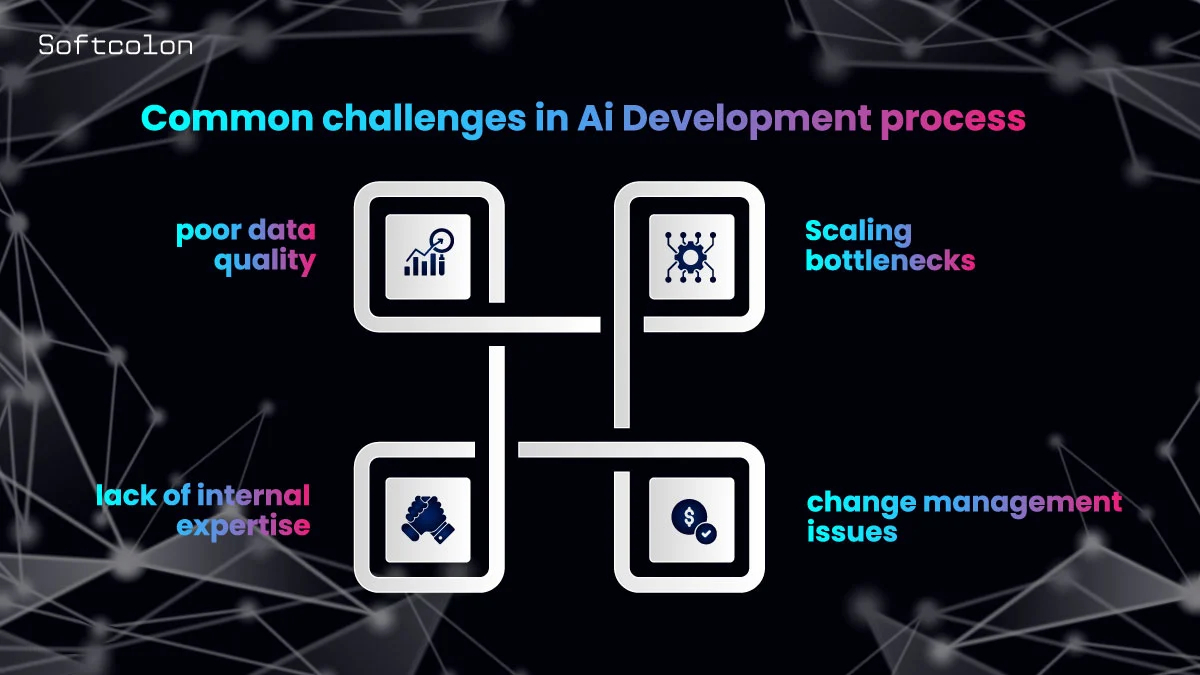
◈ Poor data quality
Since inconsistent data directly affects model performance and decision-making, poor data quality is one of the biggest obstacles to the application of AI. Unreliable forecasts can result from problems including missing values, duplicate records, out-of-date data, and biased datasets. Organizations must put in place robust data governance frameworks with procedures for data validation, cleaning, and standardization in order to combat this.
Automated tools can guarantee consistency across datasets and help in the detection of anomalies. Data integrity is further maintained over time by routine audits and monitoring. Errors are also decreased early in the pipeline when data collection techniques are improved at the source.
Data is kept current and in line with goals through cooperation between technical teams and business stakeholders. Investing in high-quality data helps organizations achieve scalable and sustainable results. The AI development process consulting increases model accuracy and fosters trust in AI systems.
◈ Lack of internal expertise
The adoption of AI can be considerably slowed down and its long-term success limited by a lack of internal expertise. An organization may fail to hire experts for various roles. Businesses should concentrate on upskilling current staff members through formal training programs, certificates, and practical workshops in order to address this issue.
Collaborating with AI service providers can expedite implementation and give instant access to specialized knowledge. Organizations should strive to build internal competencies over time in order to lessen reliance on outside assistance. Businesses may overcome skill shortages and build a solid basis for successful AI initiatives by investing in personnel development and strategic partnerships.
◈ Scaling bottlenecks
Due to infrastructural limits, growing data quantities, and performance constraints, scaling AI systems from early prototypes to full-scale production frequently poses major hurdles. Firms can sense complications when the system isn’t scalable. Adopting distributed or cloud-based architectures overcomes this by enabling flexible resource allocation and improved management of heavy workloads.
Model deployment, monitoring, and scaling procedures are made more efficient by putting MLOps concepts into practice. Effective load-balancing strategies and a generative AI development process support system performance during periods of heavy demand. To find and fix bottlenecks early, ongoing performance testing and optimization are also crucial. Scalability planning during the design stage guarantees smoother growth and minimizes future issues.
◈ Change management issues
Employee resistance may hamper the successful implementation of AI, making change management an essential but sometimes disregarded component of AI adoption. Organizations must prioritize open communication about the goals and advantages of AI, highlighting how technology matches and enhances human functions rather than replacing them, in order to overcome this.
Offering a thorough training program enables staff members to get the self-assurance and abilities needed to collaborate with AI systems. Early team involvement in the implementation phase minimizes resistance. A culture of innovation and ongoing learning requires strong leadership support. Acknowledging and appreciating flexibility also promotes good involvement. Organizations may guarantee more seamless transitions and optimize the efficacy of AI-driven transformations by proactively addressing issues and encouraging teamwork.

Ready to Scale with AI? Turn Vision into Reality
AI is more than a trend now; it’s a fundamental tool to make smart & faster business operations. From automation to smart insights, AI is changing the way organizations work. The path to AI development doesn’t need a massive upfront cost, but it requires a skilled AI development services provider and the right technology.
A successful agentic AI development process is a crucial skill that helps to make a real-world impact. With the right approaches, from effective model design to containerization and robust MLOps pipelines, businesses can verify that AI solutions perform reliably at scale. By applying the above best practices by a custom AI development company, you can successfully deliver value to users around the world.