AI has basically moved past the stage of emerging tech, and now it’s like a critical force in how global business transforms. Lots of organizations, across many industries, are adopting artificial intelligence to smooth out operations, boost decision-making, speed up innovation, and make customer experiences feel more tailored or even a bit more intuitive. And as competition keeps rising, businesses are hunting for smarter methods to get more efficiency out of things while still spotting fresh avenues for growth.
This shift explains why business leaders are making AI a strategic investment priority. Instead of treating AI as some experimental initiative, companies are integrating it into the actual core business functions to achieve measurable outcomes. A recent industry survey showed that 42% of large organizations have already integrated AI into their business operations, and other businesses are moving fast with their adoption plans, so they don’t fall behind. This broader uptake shows how much more confidence businesses now have in AI’s ability to deliver actual business value.
The demand for advanced AI development services is also rising, as organizations look for tailored solutions that actually sync with their objectives, industry requirements, and long-term digital transformation strategies. Organizations are investing in solutions like intelligent automation, predictive analytics, and AI-driven customer interaction tools to boost long-term competitive performance. In a way, it helps them stay ahead, with a sustained advantage.
At the same time, emerging AI innovations are quietly remaking how companies compete, run daily operations, and even invent new offerings. Understanding these changes is important if organizations want to stay ahead of market swings. This guide walks through the AI development trends that really matter, the ones shaping business worldwide, and it points out what decision makers should keep in mind while preparing for the next phase of AI-driven growth.
Why AI Development Is Becoming a Strategic Business Priority
Artificial intelligence is starting to feel like a boardroom, not just a tech experiment, because organizations keep putting more funding into modernization, better agility, and new revenue sources. The fast shift of AI development trends is pushing demand for smarter systems that help with steady growth, and also support a real competitive edge.
➔ The Shift from AI Experimentation to Enterprise Adoption
Companies are moving past lone AI pilots and adopting enterprise-wide plans that weave AI throughout multiple departments. In practice, executive teams are putting more funding into scalable work, and they’re starting to see AI as a long-term growth spark, something that can boost performance, fuel new ideas, and strengthen organizational resilience, too.
➔ Key Business Benefits Driving AI Adoption
AI adoption brings real value, measurable results through smoother operations, more data-led decision-making, and better customer engagement. Instead of getting stuck in complicated reports or messy data, AI helps turn that complexity into clear, practical insights. That way, teams can run things more efficiently, react quicker to market shifts, and build tailored experiences for each customer, which then supports stronger satisfaction and higher loyalty.
Generative AI Continues to Transform Business Operations
Generative AI is on the brink of embedding itself deeper into core business processes outside of content generation. The most evident enabler of the use of AI at the organizational level is productivity gains. Generative AI has the potential to disrupt and improve processes and productivity by optimizing cross-department and cross-functional collaboration by sharing knowledge at unprecedented levels.
⇒ Enterprise Use Cases for Generative AI
Generative AI is being used across different organizations to make content creation, to organize knowledge resources, help in software engineering tasks, and to smooth out customer interactions, too. All of these reduce efforts and improve the quality and speed of responses and development. This allows employees to dedicate their time and resources to initiatives and problem-solving strategies that are of high value to the business.
⇒ How Businesses Are Scaling Generative AI Initiatives
Organizations are moving toward internal AI assistants and are also building department-focused solutions, while at the same time executing enterprise-wide adoption plans. And as the future of AI development trends keeps evolving, teams are realizing they need scalable oversight, security guardrails, and solid integration frameworks if they want to achieve real long-term business value out of it. In real-world settings, success depends not only on implementing AI models but also on making sure their long-term reliability and real-world effectiveness stay steady.
The Rise of Enterprise AI Agents
In many companies, enterprise AI agents are really changing how automation works, because these systems can make contextual decisions, carry out tasks on their own, and keep multiple steps of a workflow moving. Basically, instead of just following a script, they can manage the whole thing. A lot of organizations also work with a custom AI development company, so they can implement smarter agents that lighten the workload and raise day-to-day operational performance.
◈ What Are Enterprise AI Agents?
Enterprise AI agents are basically intelligent software applications, capable of processing data, making informed decisions, and then executing specific tasks with limited human involvement. Rather than traditional automation that just follows strict pre-written rules, these agents can adapt when things change and react in a more fluid manner to evolving business needs, like customer context, workflow shifts, and shifting priorities. In other words, they don’t just execute a fixed script; they reason and act.
◈ Business Functions Benefiting from AI Agents
AI agents also bring real value for sales, customer support, day-to-day operations, supply chain management, human resource management, and finance. AI Agents allow companies to automate ordinary, repetitive tasks, facilitate better and faster resource management, and assist in faster and more efficient critical business process execution.
◈ Why AI Agents Are a Major Trend in 2026
AI agents are showing up as one of the latest AI development trends, mostly because they can autonomously finish tasks, keep learning from new interactions, and get better at performance over time. Also, they reduce the need for manual involvement, which makes them useful assets for business operations that need to scale smoothly.
Also Read: AI Development Process: How Companies Build Scalable AI Solutions from Idea to Deployment
AI-Powered Business Process Automation Reaching New Levels
Automating business processes using AI is not only about completing the routine tasks. Automation is becoming smarter and analyzing data to create workflows that help in decision-making. These workflows are dynamic and can change according to varying situations. Businesses that utilize AI development services are creating scalable systems that improve the efficacy and consistency of business operations.
✧ Evolution Beyond Traditional Workflow Automation
Artificial intelligence has transformed automation platforms. These platforms can now make decisions based on specific contexts and are designed to optimize workflows and automate processes based on real-time changes in the business environment. By using these systems, organizations can improve the agility of their business operations and eliminate bottlenecks. The performance of a process can be enhanced continuously without high levels of human intervention.
✧ Common Automation Applications Across Industries
Automation of business processes using AI is currently seen in invoice processing, claims processing in insurance, and the onboarding of employees. The automation of these business processes makes the completion of tasks quicker, reduces the likelihood of making mistakes, satisfies compliance requirements, and provides better experiences to end-users, employees, and operational teams.
Industry-Specific AI Solutions Are Gaining Momentum
Businesses are noticing the customization of AI solutions to their distinct sector. These AI solutions are becoming valuable investments since many industries operate under unique conditions. Tailored solutions mean AI implementation will be more efficient, accurate, and will yield better results.
⊛ AI in Healthcare
AI development services are improving the way healthcare interfaces with its clients. AI development service is especially used for improving the engagement of patients, the accuracy and efficiency of diagnostics, and the optimization of administrative services.
⊛ AI in Financial Services
Financial institutions are starting to use AI to strengthen fraud detection, strengthen risk evaluation, and make customer interactions feel more personal. Smart platforms sift through huge financial datasets in real time, which helps with quicker judgments, better protection controls, and a more adaptive banking experience. In other words, decisions come sooner, and the services feel a bit more responsive.
⊛ AI in Manufacturing and Logistics
In manufacturing and logistics environments, AI is commonly applied to equipment maintenance planning, demand prediction, and supply chain efficiency improvements. This capability helps minimize downtime, sharpen inventory planning, raise operational visibility, and also support a smoother and more efficient flow of goods across intricate networks.
Responsible AI and AI Governance Becoming Business Imperatives
As AI adoption keeps expanding, organizations are under pressure to make sure compliance, accountability, and ethical implementation happen in practice. Between the growing current AI development trends, responsible governance frameworks assist businesses in navigating risks, keeping credibility, and aligning with regulatory requirements that are still changing.
➤ Why AI Governance Matters
AI governance gives you the structure that helps make sure regulatory compliance stays on track, supports more ethical technology adoption, and minimizes operational risks. With proper oversight in place, organizations can keep things transparent, protect stakeholders, and set up real, clear accountability for AI-driven decisions plus the business outcomes that follow.
➤ Key Elements of Responsible AI Frameworks
Strong and responsible AI frameworks focus on transparency, explainability, data privacy protection, and bias mitigation consciously. Together, these ideas help organizations make systems feel trustworthy, boost decision confidence, prevent sensitive information, and support equitable results across many different users, plus real-world applications.
AI and Data Analytics Convergence Driving Smarter Decisions
AI combined with analytics is changing the way organizations understand data and the actions they take based on the resulting insights. Organizations building their predictive capabilities and choosing to make decisions on organizational operations and tactics based on insights from data in real time will become more competitive and more operationally excellent. These are business gains resulting from investing in custom AI development services.
➞ The Growing Role of AI in Business Intelligence
AI is boosting business intelligence in an automatic way, like identifying patterns on its own, then producing actionable insights and also revealing hidden opportunities. With advanced predictive analytics plus smarter reporting, leaders can decide faster and with more assurance because the information becomes clearer.
➞ Building Data-Driven Organizations with AI
With AI, organizations can form real-time business intelligence spaces that support decisions using insights that get updated continuously. The result is usually better forecasting accuracy, quicker access to key information, and planning that is backed by actual data, so the business stays agile in markets that shift fast.
Multimodal AI Expanding Enterprise Capabilities
Emerging Multimodal AI technology is becoming one of the more impactful trends in AI development, offering businesses the ability to discover value among different forms of data. By integrating different types of information, companies make their knowledge, operations, and user experience much better.
➜ Understanding Multimodal AI
Multimodal AI combines the power of several data types: text, audio, images, video, and more, creating a bridge and context for all of them. Because of this, organizations can generate insights of a much higher quality and in a more accurate way, as well as create better and more accurate business solutions.
➜ Business Applications of Multimodal AI
Businesses have adopted multimodal AI for augmented customer support, the automation of repetitive, document-driven processes, and heightened visual quality assurance. All of these features boost productivity, minimize manual effort, and improve operational precision and the effectiveness with which a business handles intricate data.
AI Development Focused on Hyper-Personalized Customer Experiences
Today’s businesses employ AI development services to design carefully tailored interaction systems that are built upon the unique customer preference and behavior data. The insights gathered through the deployment of AI enable businesses to create and implement tailored engagement strategies that are optimally relevant, thereby deepening the relationships that foster customer loyalty and retention.
➥ The Future of Customer Engagement
Customer engagement is getting way more intelligent now, through personalized recommendations, adaptive customer journey, and context-aware interactions. AI lets businesses read intent, forecast what people may need, and deliver on time, which feels really relevant in every phase of the customer lifecycle.
➥ Business Impact of Personalization
Effective personalization strategies help boost customer satisfaction because they deliver more meaningful experiences that are tuned to individual expectations. Businesses usually benefit from it when retention improves, like customers stay longer and therefore customer lifetime value goes up, plus conversions can work better since each interaction feels more relevant, more engaging, and a bit more personal overall.
Also Read: Top AI Development Companies in USA for Delivering Custom AI Solutions
Edge AI and Real-Time Intelligence Gaining Adoption
A lot of organizations are now choosing Edge AI so they can process data closer to where it gets created. With this setup, things like latency, security, and overall performance start to improve. As a result, teams can react more quickly in critical moments where immediate insights matter, and decisions have to be made in real time, not later.
◈ What Is Edge AI?
With Edge AI, organizations implement AI models on local or nearby devices. Processing data at its source minimizes the need for cloud services. As a result, organizations gain the edge of speed and efficiency in operations.
◈ Benefits for Global Businesses
Speed, security, and reliability improve operations with Edge AI. Furthermore, businesses gain the edge of consistency and support for time-critical operations and services. This also enables improved service in and through environments that have limited or interrupted network connectivity.
AI Development Talent and Skills Becoming Competitive Differentiators
The global race to adopt AI means that organizations are mobilizing to hire talent that can develop, manage, and control complex intelligent systems. Skill gaps will need to be addressed more strategically to manage and protect the organization’s investment in AI as it matures and improve the potential for continuous innovation.
→ Growing Demand for AI Expertise
There is increasing demand for AI engineers, machine learning specialists, data scientists, and AI governance consultants. These roles provide the technical, analytical, and regulatory skills needed to develop, implement, and control sophisticated AI applications.
→ Building AI-Ready Organizations
Establishing collaborations with noted AI developers/researchers, upskilling current staff, and putting specialized centers of excellence in place strengthen an organization’s foundational ability to adopt AI for transformative functions. The additions of centers of excellence allow information on AI to be shared and adopted rapidly within the organization.
How Businesses Can Prepare for the Next Wave of AI Innovation
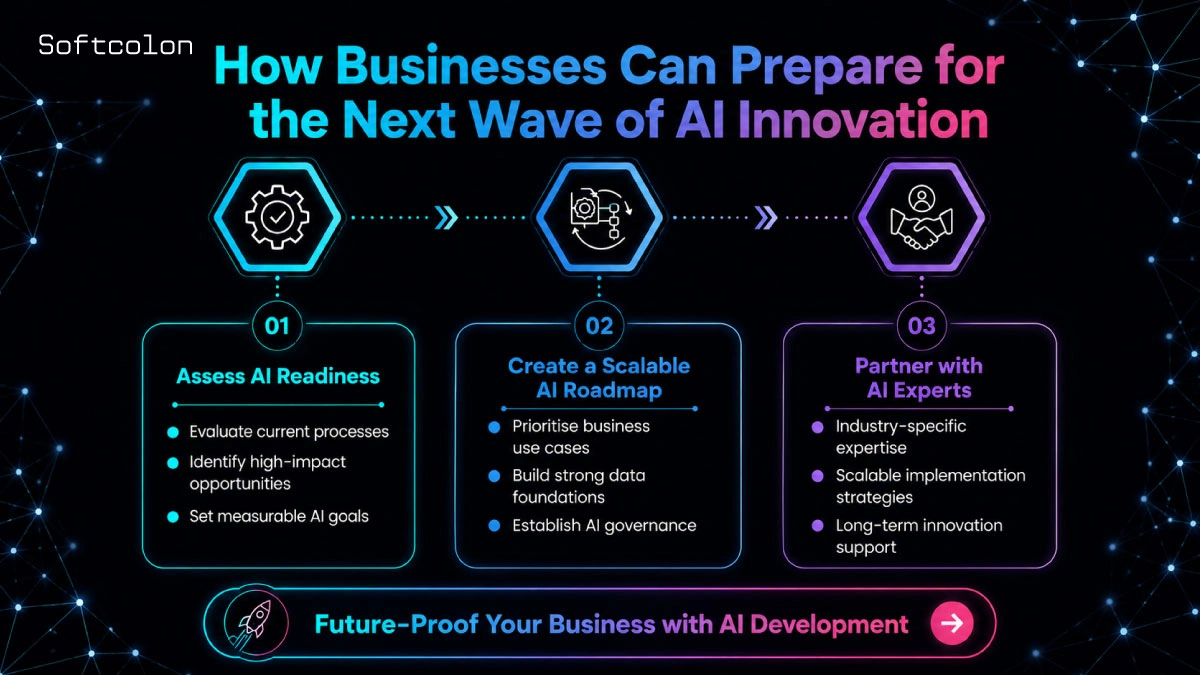
Organizations seeking sustainable AI success must establish a structured adoption strategy aligned with business objectives. Building scalable, secure ecosystems and focusing on long-term value creation lets businesses adapt quickly while also maximizing the returns that come from future AI advancements.
⦾ Assess Current AI Readiness
Assessing the state of technology, the processes used, and the data capabilities is the starting point for successful adoption of AI. In this case, it is necessary that organizations determine which challenges are the largest, what impacts are the largest, and then outline goals that are measurable and will assist in helping to integrate AI in a way that will optimize core business goals.
⦾ Create a Scalable AI Roadmap
A well-defined roadmap helps organizations pick the most valuable use cases, and it also helps them strengthen their data foundations and set up governance structures that actually stick. And because of that, this whole strategic approach tends to keep AI projects more scalable, more secure, and able to deliver reliable business outcomes over time.
⦾ Partner with the Right AI Development Experts
Experienced AI partners come with industry-focused context, scalable build approaches, and continued innovation support. Their expertise really helps companies speed up deployment, reduce risk, sidestep tough technical issues, and create solutions that keep adapting as the business needs shift.
Ready to Capitalize on the Latest AI Development Trends?
Organizations that take an early-adoption approach to quickly advancing AI innovations are more likely to achieve measurable business results by leveraging technology. Investments make work more efficient, revenues expand, competitiveness is fortified, and the business is capable of more dynamic responses to the changing marketplace.
Firms that partner with a reliable custom AI development service company will implement AI faster and more securely. Getting expert guidance is what helps surface the really high-value use cases, and it also keeps AI initiatives connected to the organization’s goals, so the solutions actually deliver something meaningful and sustainable for the business.
Also, building scalable AI solutions matters a lot if you want to support future growth and keep operations quicker. With flexible architectures, solid data foundations, and governance frameworks in place, organizations can broaden their AI capabilities with confidence while still holding the line on performance, security, and regulatory compliance across the entire enterprise.
As AI keeps reshaping industries, around the world, organizations that put money into innovation right now will be more ready for what comes next, and the real problems of tomorrow. Staying ahead in an ever-more AI-driven global market needs constant adaptation, smart strategic planning, and a real commitment to long-term tech progress.