Artificial Intelligence operates beyond the realms of niche technology. The past few years have seen the technology evolve into an essential component across business models. Organizations have moved past pilot projects to full-scale implementations, utilizing AI integration services to embed intelligence into everyday operations. Recent reports have indicated that 42% of organizations have adopted AI solutions, while another 40% are evaluating the adoption of AI solutions. The prompt adoption of AI solutions signifies that AI is a top priority in organizational business solutions.
Integrating AI has become a necessity. The market has evolved. Customers expect real-time feedback, tailored suggestions, and an easy-to-use digital platform. Businesses must handle immense volumes of structured and unstructured data. Insightful data analysis is the competitive advantage, while AI is the driver of that advantage. Organizations without AI capabilities will continue to watch their competitors with intelligent systems.
Operational efficiency is positively impacted by AI. AI automation decreases manual workloads, accelerates decision-making, and decreases errors. Researchers say that due to increasing productivity and demand, artificial intelligence will, by 2030, potentially contribute $15.7 trillion to the global economy. The importance of deploying AI resources is demonstrated by this number.
Businesses use AI to create evolutionary prospects, which has come to the fore. They utilize predictive analytics to identify trends, develop pricing models through machine learning, and improve customer service through AI. AI technology brings fundamental changes to all business functions, which include marketing and sales, operational processes, and customer service activities. AI is being leveraged to create opportunities and improve decision-making processes.
As 2026 gets closer, businesses are moving from just adopting AI to properly integrating it. The companies that select appropriate AI strategies for their operations will achieve faster growth and increased innovation capabilities and will maintain their market leadership.
What Are AI Integration Services?
◈ Definition and Scope
AI integration means bringing artificial intelligence capabilities into existing systems, apps, and workflows in business to improve functionality and performance. Rather than creating isolated, standalone AI tools, businesses focus on AI models and existing infrastructure and systems to create ecosystems that work together to improve operational performance. This includes intelligent automation (IA), ML, NLU, and sophisticated data analytics engines embedded in CRM, ERP, and customer service automation solutions.
The scope of AI integration services is broad, and with rapid tech evolution, this is also true for AI integration. AI integration is anything from automating simple, routine tasks to complex, advanced predictive analytics that further sophisticated decision making. Businesses rely on AI integration services to ensure proper implementation of business technologies that are aligned with business objectives and have set metrics for outcome achievement.
AI tools and AI integration services need to be distinguished from each other because they function differently. The specific functions of AI tools are defined by their design, which integration services use to connect those tools with existing systems for seamless data flow and system operation. The unified approach enables organizations to achieve maximum AI value because it removes operational barriers and creates a base for upcoming advancements.
◈ Key Benefits for Businesses
AI integration provides multiple advantages that directly influence the performance and expansion of businesses. The main benefit exists because businesses achieve higher operational efficiency through automated processes. The implementation of AI technology in business operations enables organizations to automate their repetitive and lengthy work processes, which include data entry, customer support, and report creation activities. The solution decreases the need for manual work while decreasing operational mistakes and enabling workers to concentrate on essential business functions.
Another major benefit is data-driven decision-making. The AI systems have the capability to process and analyze extensive data sets while they operate in real time to detect patterns and produce valuable operational insights. Organizations can utilize precise and current data to make decisions instead of using untested beliefs. The companies that implement enterprise AI integration services can achieve a competitive edge through their ability to rapidly adapt to shifts in the market and changes in customer preferences.
AI integration reduces costs through two methods, which include automated task execution and predictive analytics that detect risks before they occur. It also supports scalability, which enables efficient management of increasing system workloads. The system improves operational performance while supporting sustainable business development and ongoing innovative progress.
Why Businesses Need AI Integration in 2026
➔ Increasing competition in digital markets
Digital markets are experiencing greater competition because companies from all sectors are expanding their online operations. Companies now compete through multiple factors, which include product pricing, product quality, and their ability to deliver products, create new solutions, and provide exceptional customer service. Organizations must use advanced systems because traditional systems no longer meet their operational needs.
AI enables organizations to evaluate competitor approaches, discover untapped market potential, and develop rapid responses to evolving customer requirements. Businesses that adopt AI integration solutions can streamline operations, improve agility, and stay ahead of competitors. The absence of AI technology results in slower decision-making processes for organizations, which subsequently leads to decreased operational efficiency that directly affects their growth and market presence in 2026.
➔ Demand for personalized customer experiences
Customers today expect highly personalized interactions across every touchpoint. Personalization now serves as the main element that customers use to determine their satisfaction levels and their decision to remain loyal to a business. Businesses employ artificial intelligence to study customer behavior, together with their preferences and buying patterns, which enables them to create individualized experiences that are delivered instantly.
Organizations need AI technology to achieve their desired level of personalized customer experiences across large systems. Companies that use AI technology achieve better customer experiences through enhanced engagement, which leads to higher conversion rates.
Businesses need to implement AI-driven personalization systems to meet increasing customer expectations while staying competitive in their customer-centered operations.
➔ Real-time data processing needs
Modern businesses produce continuous data streams that originate from their customer interactions and their operational performance measurements. The ability to process and act on this data in real time has become essential for making timely and accurate decisions. AI integration allows organizations to analyze large datasets instantly, identify patterns, and respond to changes as they happen.
This situation proves crucial for the finance, e-commerce, and logistics sectors because any delay will result in either financial loss or business opportunity loss. Real-time insights enable businesses to enhance their operations while minimizing risks and enabling them to make forward-looking decisions.
➔ Workforce optimization
Organizations seeking to expand their business operations need to improve their employee productivity. The introduction of AI technology enables businesses to enhance their employee productivity through two methods: it automates repetitive work tasks and provides workers with advanced automated tools.
The work enables teams to concentrate on their strategic tasks and creative activities while they finish standard operational duties. AI provides support for workforce planning through its ability to evaluate performance metrics and forecast upcoming resource requirements. The result enables businesses to better distribute their workforce, which leads to higher operational efficiency.
Organizations that develop a workforce by implementing AI technologies would witness sustained growth and operational efficacy by the year 2026.
Also Read: Top AI Development Companies in USA for Delivering Custom AI Solutions
List of AI Integration Services Businesses Should Consider
1. AI-Powered Chatbot Integration
AI-powered chatbots provide automated customer support through rapid response systems that operate without human assistance. The systems manage frequent questions, thus achieving faster answer delivery and enhanced service performance. Businesses can provide customer support at all times because their operations enable them to serve clients from different regions without incurring extra expenses. The NLP-based system helps chatbots understand what users mean and provide accurate responses. Many organizations rely on AI integration services to seamlessly connect chatbots with CRM and support platforms for a consistent customer experience.
2. Machine Learning Model Integration
Businesses utilize machine learning model integration to transform their data into operational business intelligence. The system enables predictive analytics, which helps organizations to anticipate future developments and make proactive business decisions. Recommendation engines enhance user experience by recommending suitable products or services, which leads to better user engagement and higher conversion rates.
Fraud detection systems operate in real time to detect suspicious activities by examining patterns, which helps organizations minimize risks. The partnership with an experienced AI integration service provider allows businesses to achieve correct machine learning model implementation, which supports their operational objectives.
3. Natural Language Processing (NLP) Integration
Natural Language Processing (NLP) integration allows systems to understand and process human language. Businesses use it for sentiment analysis to evaluate customer feedback and identify trends in opinions. Voice assistants improve accessibility and user interaction by enabling hands-free communication. Text summarization tools help convert large volumes of information into concise insights, saving time and effort. Organizations can create customized NLP solutions to meet their unique communication and data processing requirements through custom AI integration services.
4. Computer Vision Integration
Computer vision systems enable machines to recognize and comprehend visual content through their advanced visual perception capabilities. Companies employ image recognition technology to detect objects and patterns, while facial detection systems improve their security and access control functions.
The manufacturing industry uses this technology for quality inspection, which detects defects instantly to maintain product quality and minimize production waste. The advanced AI integration services enable companies to implement these operational capabilities, which result in improved operational accuracy and efficiency.
5. Robotic Process Automation (RPA) with AI
Businesses use RPA and AI to automate their repetitive workflows through advanced intelligent systems, which provide better operational flexibility. The system automatically processes invoices by extracting data and validating it, which results in reduced processing times and lower error rates.
The process of automation assists human resources departments in employee onboarding, payroll administration, and the upkeep of employee records. The process enables teams to work on important tasks while enhancing operational productivity. The AI integration service provider guarantees successful system deployment, which matches current business operations.
6. AI Data Analytics & Business Intelligence Integration
Organizations use AI-powered analytics integration to transform complex data into usable operational insights. The advanced reporting tools enable users to access more detailed performance information, whereas the real-time dashboards support quicker decision-making. Businesses use predictive insights to forecast upcoming trends while detecting possible threats at an early stage. Companies that adopt advanced AI integration services will develop more intelligent analytics systems, which will enhance their strategic planning and overall business success.
7. AI in CRM & Marketing Automation
Businesses improve their customer engagement practices through AI integration in their CRM and marketing systems. The system creates customized advertising campaigns that build better customer relationships through its understanding of user habits and preferences. Lead scoring helps sales teams focus on their most promising leads, which improves their overall effectiveness.
Customer behavior monitoring is necessary as it shows how customers are interacting with a product and thus what decisions are required as regards the product. Businesses can implement these marketing capabilities through their partnership with an experienced AI integration service provider, which will help them achieve better marketing results.
8. AI in Supply Chain & Operations
Integrating AI in supply chains enables effective planning and execution. With AI in demand forecasting, businesses anticipate customer needs and avoid surplus inventory and stock-outs. More streamlined inventory management results from automated tracking. AI assists in optimizing logistics for quicker deliveries and reduced operational costs. Advanced AI integration services enable companies to create supply chains that are more resilient, responsive, and improve operational performance while minimizing disruptions.
9. AI Cybersecurity Integration
AI cybersecurity integration improves digital security through its ability to detect threats that developers have not yet discovered. The system maintains constant surveillance of its infrastructure to detect any abnormal behavior that could indicate an upcoming security breach. The system improves fraud detection through AI-based real-time transaction analysis, which identifies fraudulent patterns.
Organizations use risk assessment tools to identify their vulnerabilities, which enables them to create effective security measures. Organizations can enhance their security systems through this method while minimizing dangers and safeguarding confidential information in today’s advanced online environment.
10. Generative AI Integration
The implementation of Generative AI in business operations at this time enables businesses to create new value streams while changing how they deliver their services. The system generates automated content for marketing materials, blogs, and communication. Code generation produces complete programming solutions that speed up development work. Design automation enables users to generate visual content and prototypes in a short time period. The combination of these abilities allows businesses to boost their output while increasing their creative capacity and expanding their operations without needing extra resources.
How to Choose the Right AI Integration Service Provider
⊛ Evaluate business needs
Commence by clearly specifying your firm’s objectives and hurdles. Identify areas where AI could provide maximum benefits through its ability to automate processes, analyze data, and improve customer interactions. This precise strategy helps you sidestep needless spending and secures your integration in line with your future ambitions to yield returns.
⊛ Check technical expertise and experience
Before you make a choice, evaluate the range of technical skills and experience the potential provider has in the field. Examine their previous assignments, case studies, and the breadth of technology they have used. An experienced provider will manage the technical intricacies of the system and will deal with the seamless integration of the system with other systems.
⊛ Scalability and customization options
Select a service provider who delivers solutions that can grow to meet your specific requirements. AI systems must grow with business changes because organizations will undergo continuous development. The solution needs to adapt to your workflows because customization enables you to make necessary adjustments.
⊛ Data security and compliance
The provider needs to develop secure data protection systems that will enable them to meet all legal requirements. AI systems need protective measures because they handle sensitive information used by their operations. Organizations should implement documented procedures for data storage and access management, which will establish security protocols and ensure compliance with all applicable regulations.
⊛ Post-integration support
Successful long-term operations depend on dependable post-integration support. AI systems need ongoing updates and monitoring activities that support their performance. The provider who delivers advanced AI integration services will keep systems operating through ongoing enhancements while providing immediate solutions to problems that arise during business growth.
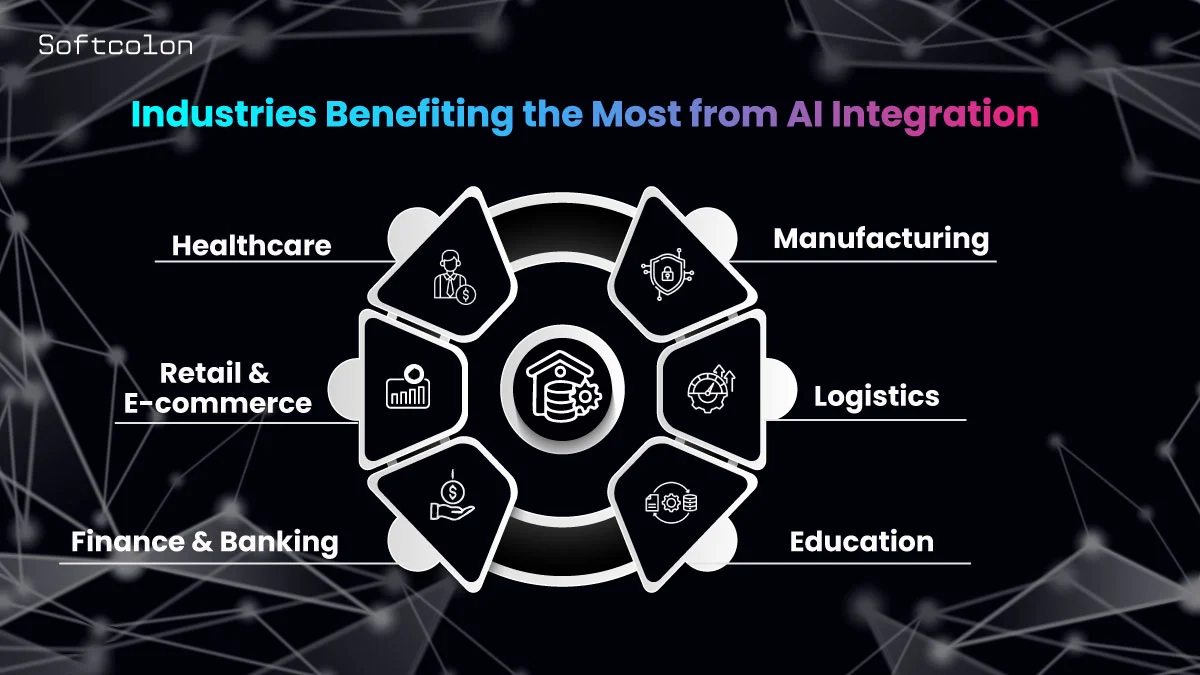
Industries Benefiting the Most from AI Integration
➱ Healthcare
Artificial intelligence is being integrated into healthcare systems to facilitate enhancements in diagnostic facilities, patient monitoring systems, and treatment planning services. The system enables rapid medical data analysis, which helps detect diseases at their initial stages while decreasing the probability of human mistakes. Hospitals implement artificial intelligence systems to control their operations, which results in improved resource management and better patient treatment methods that create efficient healthcare delivery systems and improved patient outcomes.
➱ Retail & E-commerce
Businesses in the retail and e-commerce sectors use artificial intelligence technology to develop personalized shopping experiences, which improve their customer engagement. The system studies customer purchasing patterns to suggest products and determine optimal pricing methods. Businesses use artificial intelligence to boost their inventory control and demand prediction abilities, which results in decreased waste and higher revenue while providing customers with a consistent online shopping experience across their digital platforms.
➱ Finance & Banking
Finance and banking sectors use AI technology to enhance their capabilities for detecting fraudulent activities, assessing risks, and providing customer support services. The system analyzes massive amounts of financial information in real time to detect suspicious activities, which it uses to stop fraudulent activities. The financial sector uses AI technology to power its automated services, which include chatbots and credit scoring systems that deliver faster results while enhancing security measures and providing superior customer service.
➱ Manufacturing
AI enhances manufacturing operations through predictive maintenance, quality control, and production optimization. AI systems monitor equipment performance to prevent breakdowns and reduce downtime. They also detect defects during production, ensuring consistent quality. The process results in higher efficiency and reduced operational expenses while it creates a better manufacturing workflow.
➱ Logistics
With the help of AI, route planning, demand forecasting, and tracking of shipments have become more efficient in logistics operations. The system enables companies to enhance their delivery operations while decreasing their transportation expenses and maintaining fast response times during operational interruptions. Real-time tracking creates enhanced visibility throughout the supply chain, which leads to on-time deliveries and boosts total operational performance.
➱ Education
Artificial intelligence enhances educational systems through its capacity to create customized learning pathways while streamlining administrative procedures. The system evaluates student performance to deliver customized learning materials and assistance. The system enables educators to monitor student development, while educational institutions achieve operational efficiency through automated grading and scheduling processes, which leads to better academic performance and more effective educational systems.
Future Trends in AI Integration (2026 and Beyond)
➢ Rise of autonomous AI agents
Autonomous AI agents develop their abilities to work without needing ongoing human assistance. The systems develop the ability to analyze data and make decisions while they implement actions in real-time operations. Businesses are increasingly adopting AI integration solutions to deploy such agents, which improve operational efficiency by reducing the need for manual work and enabling operations to run faster with more intelligent capabilities across different business functions.
➢ Hyper-personalization
Hyper-personalization has progressed from its initial recommendation system to provide users with real-time, customized experiences. Artificial Intelligence studies how users behave, what they prefer, and how they interact with systems to develop personalized content, which includes specific offers and communication elements. This approach enables businesses to build better customer relationships while increasing customer engagement and driving higher conversion rates through more effective personalized marketing efforts.
➢ Edge AI adoption
Businesses are turning to Edge AI since it provides them with quick data processing capabilities and lower data processing delays. The AI models operate from locations that are nearer to their data sources, which include devices and local servers instead of depending on centralized systems. This system advances response abilities while boosting system efficiency and enabling applications that need instant decision-making capabilities in Internet of Things systems and interconnected environments.
➢ Ethical AI and governance
Organizations now prioritize ethical standards and governance structures because of the increasing use of AI technologies. Organizations need to accomplish main goals, which include establishing transparent systems for their operations, creating bias-free algorithms, and establishing systems to track their decision-making activities. Strong governance helps build trust, ensures compliance with regulations, and supports responsible use of AI technologies across industries.
Also Read: AI Development Process: How Companies Build Scalable AI Solutions from Idea to Deployment
Security, Ethics & Compliance in AI Integration
• Data privacy concerns
AI systems process extensive datasets, which include sensitive information and personal identification data, thus making privacy protection their fundamental challenge. Organizations need to establish robust encryption systems, protected storage solutions, and strict user access permissions to maintain constant protection of customer information.
• Ethical AI usage
Ethical AI aims to establish equitable decision-making processes through transparent systems that maintain their decision-making processes. Organizations need to assess their algorithms for bias while creating systems that explain their operation and provide users with equitable treatment to establish trustworthy AI systems.
• Regulatory considerations
Businesses need to follow security requirements that protect personal information and specific industry standards when they implement artificial intelligence systems. The organization can achieve responsible data handling through its legal compliance, which also protects against sanctions and maintains trustworthiness in the face of growing digital regulatory requirements.
Ready to Choose the Right AI Integration Services for 2026?
AI integration has transformed into an essential business requirement for organizations in 2026 because it provides companies with a competitive advantage. Businesses that partner with the right AI integration service provider can unlock efficiency, improve decision-making, and enhance customer experiences. The selection of appropriate services creates an immediate effect on return on investment because it connects business objectives with technological solutions, which enable organizational expansion.
Early adopters are currently obtaining a significant advantage because they use AI technology to create new products and improve their business operations. Companies that act now will establish themselves as market leaders, and those that wait will lose their competitive edge in today’s business environment, which depends on artificial intelligence.